

Top Parmco Rangehood NZ Picks | Find Your Perfect Fit
When you choose a Parmco rangehood, you’re getting more than just a kitchen appliance; you're investing in a product designed specifically for New Zealand homes. With over 30 years of local experience, Parmco has nailed the balance between powerful, reliable performance and great value, all backed up by a service network that spans the country.
Why Parmco Is a Smart Choice for Kiwi Kitchens
If you're in the thick of a kitchen renovation or building a new home, the list of appliance brands can feel endless. It's easy to get lost in the big international names, but there’s a compelling reason to look a little closer to home. For thousands of Kiwis, Parmco is the go-to, and it’s not hard to see why. This isn't just about buying a piece of equipment; it's about picking a brand that truly gets the unique demands of a New Zealand kitchen.
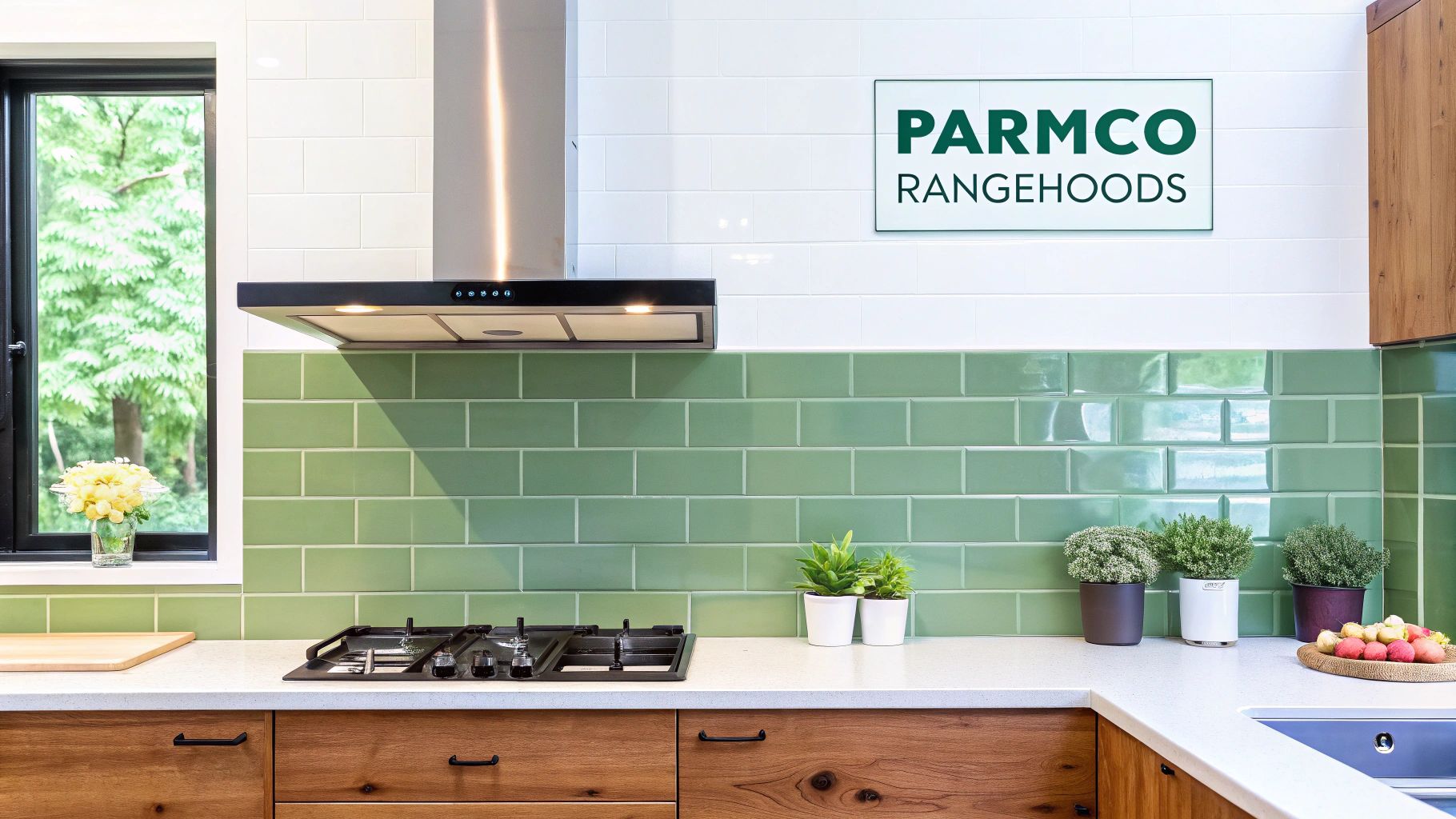
This deep-rooted local focus is Parmco's secret sauce. While global companies often push a one-size-fits-all product, Parmco has spent decades gathering direct feedback from New Zealanders. This constant conversation helps them fine-tune their designs to tackle our specific challenges, like dealing with moisture in our humid climate or fitting perfectly into typical Kiwi kitchen layouts. To really get why this matters, it helps to understand the key roles of a rangehood in the first place.
Built for New Zealand Conditions
A massive benefit of Parmco's local insight is that they make appliances that genuinely work well here. Their entire approach is built on delivering premium quality without the eye-watering price tag you might see on some European brands.
By keeping their manufacturing efficient and their local distribution sharp, they manage to keep costs down while maintaining incredibly high standards. It’s this blend of clever design and practical value that really makes Parmco stand out. Their rangehoods include features that actually make sense for the way we live.
Parmco’s success isn't complicated. They create appliances that solve real problems for New Zealanders, offer them at a fair price, and provide after-sales service you can count on. It’s a model built on trust.
The Peace of Mind of Nationwide Support
Maybe the most convincing reason to go with a Parmco rangehood is the confidence that comes from their nationwide service network. Getting support for an international brand can sometimes feel like a mission, but Parmco has technical help and service agents right across the country.
This commitment to looking after you after the sale provides incredible peace of mind. Knowing that a real person is just a phone call away if you ever need them turns a simple purchase into a secure, long-term investment for your home. This reliable support cements Parmco's place as a trusted name in Kiwi kitchens everywhere.
Matching a Parmco Rangehood to Your Kitchen Style
Picking a rangehood is about so much more than just function; it’s a design choice that can completely define the feel of your kitchen. A Parmco rangehood NZ isn't just another appliance—it can be a bold statement piece, a hidden helper, or a clever space-saver. The trick is to find the one that fits not just your cooktop, but your kitchen's entire personality.
Think of it like choosing the right lighting. A big, dramatic pendant light creates a totally different vibe from subtle, recessed downlights. The same goes for your rangehood. Your kitchen layout, how often you cook, and your personal style will all point you toward the perfect fit.
Canopy Rangehoods: The Statement Piece
Canopy rangehoods are the confident centrepieces of the kitchen. Mounted directly on the wall or from the ceiling, they're designed to be seen and admired. A canopy model is the go-to choice for a home chef who wants their kitchen to look and feel like a serious cooking space.
They work especially well in larger kitchens or where the hob is a focal point, maybe set against a beautiful splashback. Parmco has a fantastic selection, from sleek stainless steel designs that feel timeless to striking black glass models for a bit of modern drama.
Because they’re so visible, their performance usually matches their presence. These units are built to handle the heat, steam, and sizzle from frequent frying, searing, or wok cooking.
Undermount Rangehoods: The Invisible Workhorse
If you're after a clean, minimalist aesthetic, an undermount rangehood is exactly what you need. These clever units are integrated directly into your overhead cabinetry, making them virtually disappear. All you’ll see is a slim, discreet panel tucked away underneath the cupboard.
This creates that seamless, unbroken line of cabinetry that's so popular in modern kitchen design. It lets other features—like your stone benchtops or cabinetry finish—take centre stage.
Don't let their hidden design fool you, though. Parmco’s undermount models pack a serious extraction punch, quietly getting on with the job of clearing steam and smells without interrupting your kitchen’s streamlined look.
For many Kiwis doing a reno, it boils down to this: visual impact versus seamless integration. A canopy rangehood proudly says, "I'm a serious kitchen," while an undermount model whispers, "Everything in its place."
Slide-Out Rangehoods: The Space-Saving Solution
Working with a smaller kitchen? For compact spaces, apartments, or any layout where every centimetre counts, a slide-out rangehood is a brilliant problem-solver. It stays neatly tucked away when you're not cooking, looking like nothing more than a slim metal strip.
When it’s time to cook, you just pull the front panel out, which automatically switches on the fan and lights. This extends the capture area right over your pots and pans for effective ventilation. Once you’re done, slide it back in. Easy.
This type of Parmco rangehood is the master of practicality, giving you powerful ventilation precisely when you need it and disappearing when you don’t.
Which Parmco Rangehood Type Is Right for You?
Still weighing up the options? This quick-glance table can help you match a rangehood style to your kitchen and the way you cook.
| Rangehood Type | Ideal Kitchen Layout | Key Advantage | Best Suited For |
|---|---|---|---|
| Canopy | Open-plan, larger kitchens with a focal point cooktop | Maximum visual impact and high-performance extraction | Passionate cooks who want a statement appliance |
| Undermount | Modern, minimalist kitchens with seamless cabinetry | Discreet integration that maintains clean design lines | Homeowners who prioritise a sleek, uncluttered aesthetic |
| Slide-Out | Compact kitchens, apartments, or space-conscious designs | Space-saving functionality that activates on demand | Practical layouts where maximising space is a priority |
At the end of the day, choosing the right rangehood is a balance between performance and personality. If you want to get into the nitty-gritty of extraction rates and sizing, our guide on how to choose your rangehood has all the details. By thinking about your kitchen's unique character first, you'll find a Parmco model that not only works beautifully but looks like it was designed just for your space.
Calculating The Right Size and Extraction Power
Picking the right Parmco rangehood isn't just about what looks good in your kitchen. It's a technical choice that makes a real difference to how fresh and clean your air is. Two things matter more than anything else: the physical size of the unit and its extraction power. Get these right, and you'll have a rangehood that actually captures steam, smoke, and cooking smells instead of just making a racket.
Think of it like trying to catch rain with a bucket. If the bucket's too small for the downpour, you'll get spillage everywhere. It's the same with a rangehood – if it's narrower than your cooktop, steam and grease will just curl around the edges and escape into your kitchen.
Matching Rangehood Width To Your Cooktop
Here’s the golden rule: your rangehood needs to be at least as wide as your cooktop. So, for a standard 60cm Kiwi cooktop, you need a 60cm rangehood at a minimum. If you've got a bigger 90cm hob, you’ll need a 90cm rangehood to keep up. Simple as that.
In fact, going a little wider is even better. A wider rangehood creates a bigger 'capture zone', making sure that even the steam billowing off a big pot on the front element gets sucked up and away. For a 60cm cooktop, upgrading to a 75cm or 90cm rangehood can make a noticeable difference in performance.
A correctly sized rangehood is your first line of defence. By physically covering the source of the steam and fumes, it stops them from ever escaping into your home, protecting your cabinetry and keeping the air clean.
If you want to get into the nitty-gritty of measurements, you can learn more about how to choose the right rangehood sizes in our detailed guide. It's packed with tips to ensure a perfect fit.
Calculating The Right Extraction Power
Once you've sorted the size, it's time to think about power. This is measured in cubic metres per hour (m³/hr), which is just a fancy way of saying how much air the fan can shift. A higher number means more grunt, but bigger isn't always better. You need the right amount of power for your kitchen's size.
You can work out what you need with a quick calculation:
-
Figure out your kitchen's volume: Multiply the length x width x height of your kitchen (in metres).
- For example: A kitchen that's 4m long, 3m wide, with a 2.4m stud has a volume of 28.8 m³ (4 x 3 x 2.4).
-
Aim for 10 air changes per hour: For decent ventilation, you want all the air in your kitchen to be completely replaced at least 10 times every hour.
-
Find your minimum power: Multiply your kitchen's volume by 10.
- Using our example: 28.8 m³ x 10 = 288 m³/hr.
So, for that kitchen, you'd need a Parmco rangehood with an extraction rate of at least 288 m³/hr. Keep in mind, this is your baseline. If you love high-heat cooking like searing a steak or firing up the wok, you'll want a model with a much higher rate to handle all that extra smoke and sizzle.
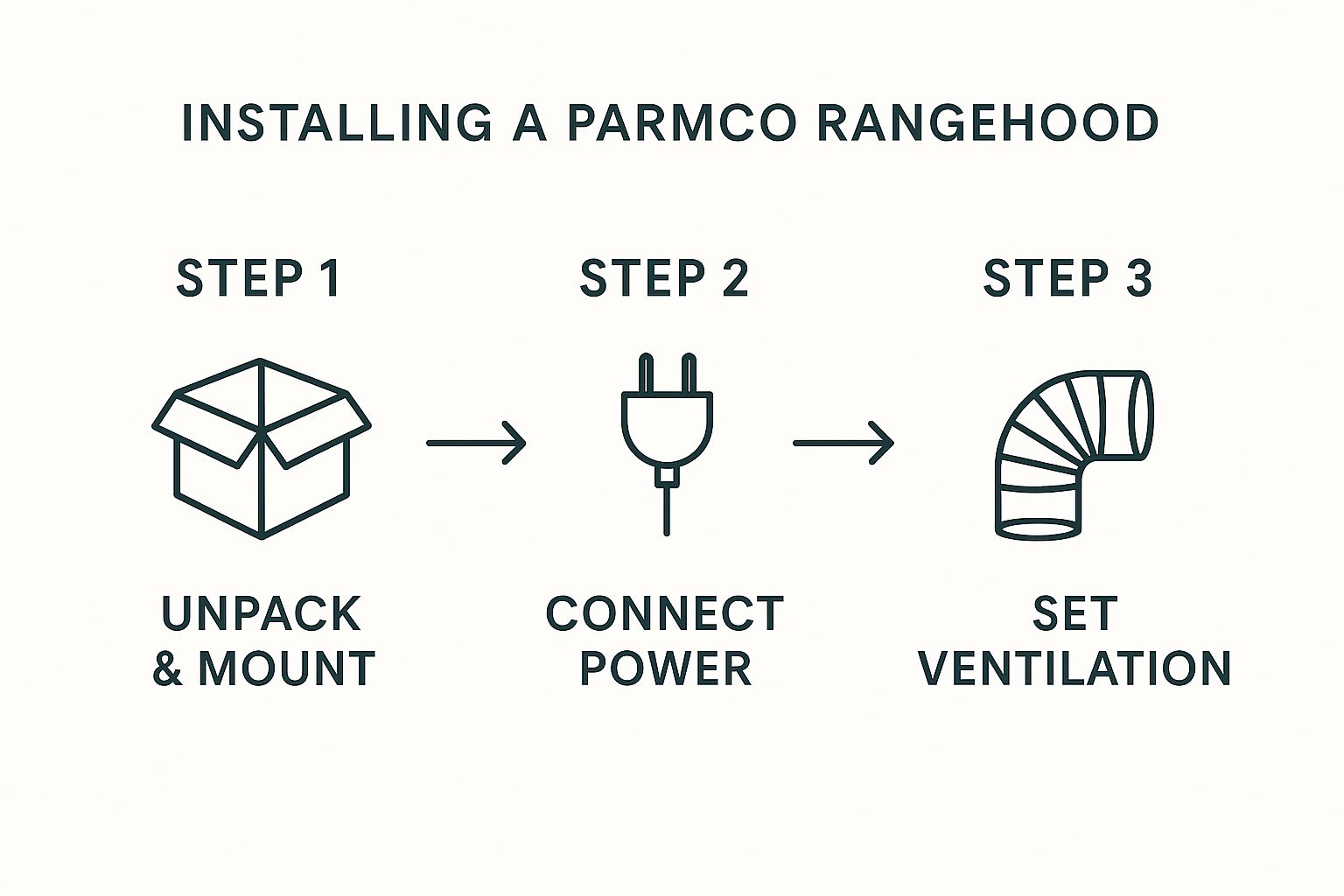
As you can see, a proper setup involves more than just hanging it on the wall. The mounting, power connection, and especially the ventilation path are all crucial for getting the performance you paid for.
Ducting vs. Recirculating: A Critical Choice
Finally, you need to decide how your rangehood will get rid of all that air it's captured. You've got two main options: ducting or recirculating.
-
Ducted: This is the best-case scenario. The rangehood vents all the contaminated air straight outside through ducting installed in your ceiling or wall. It’s the most effective way by far to get rid of moisture, grease, and odours for good.
-
Recirculating: This is the workaround for when ducting outside just isn't an option. The air gets pulled through charcoal filters to scrub out the smells before it's blown back into the kitchen. It’s convenient, but it doesn't remove moisture or heat from the room.
Here in New Zealand, where we're always fighting to keep our homes dry and mould-free, ducting is always the superior choice. By physically expelling steamy air outside, a ducted Parmco rangehood plays an active role in creating a drier, healthier home.
Diving into Modern Parmco Rangehood Features
A good rangehood does more than just clear the air these days. Modern units are packed with clever features designed to make your time in the kitchen easier and far more pleasant. Think of a Parmco rangehood NZ not just as an extractor fan, but as a core part of your cooking setup, marrying serious performance with smart, user-friendly design. These aren't just gimmicks; they're thoughtful additions that genuinely improve how your kitchen works.
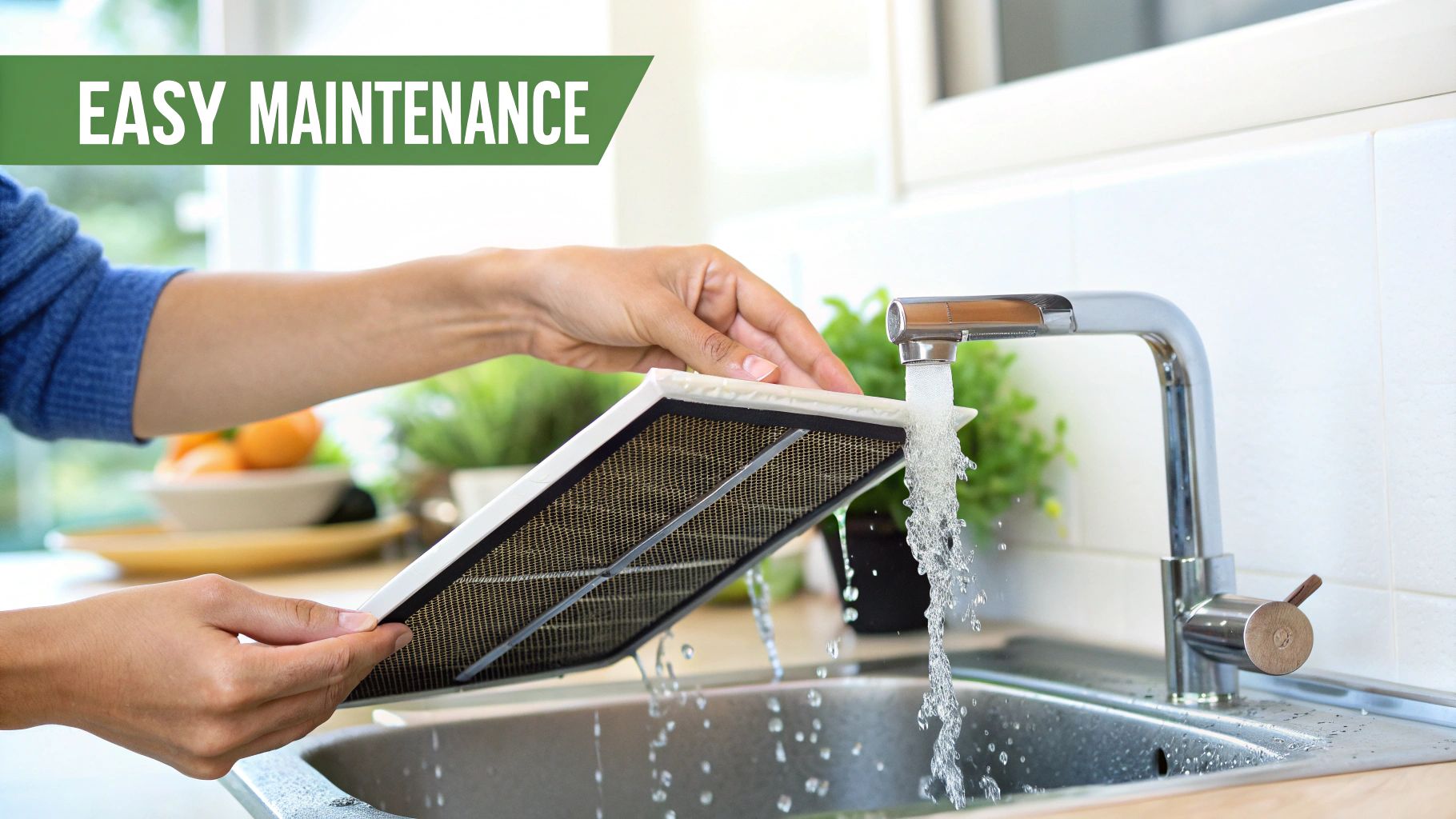
From the type of filter it uses to how you control the fan speed, every detail plays a part in its overall performance. Getting to know these features is the key to picking a model that not only looks fantastic but also works perfectly for the way you cook.
The Great Filter Debate: Baffle vs Mesh
The filters are your rangehood’s first line of defence against airborne grease. Parmco uses two main types, and each has its own strengths depending on your cooking habits.
-
Baffle Filters: These are the real workhorses, built from tough stainless steel. They work by making the air zig-zag, which forces heavy grease particles to drop out and get trapped in collection channels. If you love high-heat cooking—think searing steaks, wok frying, or Sunday morning bacon—baffle filters are brilliant. They’re incredibly durable, a breeze to clean (most can just go in the dishwasher), and they keep pulling air efficiently even as they get dirty.
-
Mesh Filters: Made from layers of fine aluminium mesh, these filters are fantastic at trapping grease from your everyday cooking. For most households, they do an excellent job and offer great value. They do need a clean a bit more often to stop them from getting clogged, but they’re usually simple to pop out and wash.
Intuitive Controls and Efficient Lighting
Modern convenience is all about making things simple, and Parmco gets this right with easy-to-use controls. Many models now have sleek touch controls that just need a light tap, getting rid of clunky buttons and leaving a smooth surface that’s super easy to wipe down.
This practical approach is really a hallmark of the Parmco brand. Their cooktops, for example, nail the features that suit a typical Kiwi kitchen: simple touch controls, a sleek black glass finish, and a standard 60cm size that fits most benchtops. This mix of smart design and affordability is why so many people trust them.
Another big plus is the bright, energy-efficient LED lighting that’s now standard on most models. Good light is absolutely essential when you’re cooking, and these LEDs light up your whole cooktop perfectly without using much power or adding extra heat.
A quiet rangehood is no longer a luxury—it’s a necessity for modern living. In an open-plan space, the difference between 55 dBA (a normal conversation) and 65 dBA (a busy restaurant) is the difference between a peaceful evening and a disruptive roar.
Understanding Noise Levels and Fan Speeds
Noise is a massive factor, especially in the open-plan homes so many of us have in New Zealand. Rangehood noise is measured in decibels (dBA), and a lower dBA number means a quieter machine. A quiet rangehood lets you cook, chat, and live without having to shout over a noisy fan.
Having multiple fan speeds gives you total control. You can use a low, quiet setting for gently simmering a soup, then crank it up to full power to clear the smoke from a sizzling stir-fry in seconds. This flexibility means you always have the right amount of power exactly when you need it, without the unnecessary noise
Getting the Most Out of Your Rangehood: Installation and Maintenance
A powerful **Parmco rangehood NZ** is a fantastic addition to any kitchen, but its performance really comes down to two things: a solid installation and a bit of regular upkeep. Getting the setup right isn't just a suggestion; it’s what unlocks its true power, ensuring it works safely and effectively for years to come.
Think of it like tuning a performance car – you can have the best engine in the world, but without a proper tune-up, you'll never feel its full potential. The same goes for your rangehood.
The Golden Rules of Installation for Kiwi Kitchens
Installing a rangehood is a game of millimetres, and getting the height right is the most important rule. It’s not about aesthetics; it’s about creating the perfect capture zone for steam, smoke, and odours.
- For electric cooktops: The base of your rangehood needs to be at least 600mm above the cooking surface.
- For gas cooktops: You'll need a bit more space for safety, so aim for a minimum of 650mm.
If you go too high, steam and odours will escape into your kitchen before the fan can grab them. Too low, and it becomes a potential fire hazard and gets in the way while you're cooking.
If you’re installing a ducted model, the next rule is to keep the ducting path to the outside as short and straight as you can. Every bend and corner adds resistance, which reduces the airflow and makes your rangehood work harder than it needs to.
"Venting a rangehood into the roof cavity is not recommended, as humidity and grease can build up in the attic, causing mould growth and other problems. For best results, always vent the rangehood directly to the outside."
This is a big one here in New Zealand, where keeping homes dry and healthy is always a priority. For ducted systems, we always recommend getting a professional installer to make sure it’s done right, meets local building codes, and is sealed properly to prevent any performance loss.
A Simple Maintenance Routine for a Long-Lasting Rangehood
Once your Parmco rangehood is up and running, a little TLC is all it takes to keep it performing at its best. Thankfully, it’s not complicated. The two key areas to focus on are the filters and the exterior surfaces.
Keep Your Filters Clean
The filters are your first line of defence against grease. Once they get clogged, airflow plummets, and the motor has to strain to pull air through.
- Mesh Filters: These are common in many models and should be cleaned every 2-4 weeks. The easiest way? Just pop them into your dishwasher on a hot cycle.
- Baffle Filters: These heavy-duty filters, often found in more powerful units, can usually go 4-6 weeks between cleans. They’re also typically dishwasher safe.
A quick clean is all it takes to keep the air moving freely and maintain that powerful extraction you paid for.
Caring for Stainless Steel Surfaces
To keep the stainless steel looking sharp, give it a regular wipe-down with a soft microfibre cloth and some warm, soapy water. The trick to a streak-free finish is to always wipe in the direction of the steel's grain. Stay away from harsh, abrasive cleaners or scouring pads, as they’ll leave permanent scratches. It’s a simple habit that stops grease from building up and keeps your kitchen looking clean and modern.
Right, you’ve picked out the perfect model. So, where do you actually get your hands on a Parmco rangehood in NZ?
As a long-standing Kiwi brand, Parmco has made sure their rangehoods are easy to find. You’ll see them in major appliance stores and specialised kitchen showrooms right across the country, so you’re never too far from a stockist.
Many people like to see and touch an appliance before buying, and that’s where physical showrooms really shine. You can get a proper feel for the build quality, check out the finish under real lights, and even play with the controls. But if you prefer shopping from the comfort of your couch buying online from nationwide retailers like folders appliances is a great option.
Major Retailers and Online Stores
Finding a Parmco stockist is pretty straightforward. They’re carried by some of New Zealand’s biggest names in appliances and home improvement, which is great because you can often snag a competitive price or a bundle deal if you're buying a few things for your kitchen reno.
You’ll typically find a great selection at places like:
- Large national appliance chains: These guys usually have a wide range on the floor and staff who can walk you through the options.
- Leading home improvement stores: A great one-stop shop if you're in the middle of a project and need to pick up everything at once.
- Independent kitchen specialists: If you’re after more personalised service and advice tailored to a specific kitchen design, these smaller retailers are fantastic.
- Online retailers like Folders: For pure convenience and often sharp pricing, online stores lay out all the specs and deliver straight to your door.
The Unbeatable Value of a 7-Year Warranty
Now, let's talk about one of the biggest reasons people choose Parmco: their industry-leading 7-year warranty. This isn’t just a nice little extra; it’s a massive vote of confidence from Parmco in the quality and durability of their own gear.
Think about it. Most appliances come with a standard one or two-year warranty. Seven years of cover is practically unheard of. It means your investment is protected from manufacturing faults for the better part of a decade. That’s a serious commitment to Kiwi customers and offers a level of security that few other brands can come close to.
This long-haul warranty, backed by a nationwide service network, is what really sets Parmco apart. It speaks directly to what New Zealanders care about most: buying something that’s built to last.
This isn’t just a hunch, either. Consumer research consistently shows that performance and reliability are the top priorities for nearly 30% of Kiwis buying new ovens, with functionality a close second at 27%. Ultimately, choosing a Parmco rangehood is more than just a purchase; it’s a smart, long-term investment in your home. With that incredible warranty and a local support team behind you, it’s a decision you can feel good about for years to come.
Got a Few Last Questions About Parmco Rangehoods?
It’s completely normal to have a few final questions pop up just as you’re about to make a decision. Getting straight answers to those nagging queries is the key to feeling good about your choice. Let’s run through some of the most common questions we hear about picking and using a Parmco rangehood NZ.
Think of these as the practical details that make a real difference to your daily kitchen life. Nailing them down now means you’ll get the absolute best performance from your new rangehood down the track.
Ducted or Recirculating: Which One Should I Get?
This is probably the most important question of all, and thankfully, the answer is usually pretty straightforward. For most New Zealand homes, a ducted rangehood is almost always the best way to go. Managing moisture is a huge deal in our climate, and this is your frontline defence in the kitchen.
Ducted models work by physically capturing all the steam, smoke, cooking smells, and grease and venting it straight outside. If your kitchen is on an external wall or has decent access to the roof space, ducting is a no-brainer.
So, when would you use a recirculating model? They're really a solution for tricky situations where ducting just isn't an option—think some apartments, or kitchens stuck on an internal wall with no easy vent path. These units pull air through carbon filters to neutralise odours before sending the air back into the kitchen. They do a decent job with smells, but it's vital to remember that they do not remove moisture.
In a Kiwi home, where battling condensation is half the winter challenge, a ducted system wins hands down. It actively gets rid of the problem-causing air instead of just trying to clean it.
What’s the Deal with the M³/Hr Extraction Rate?
That m³/hr number you see (cubic metres per hour) is just a simple measure of grunt. It tells you exactly how much air the rangehood’s fan can shift in one hour. Bigger number, more powerful fan. Simple as that.
To get a rough idea of the minimum power your kitchen needs, you can use a quick calculation:
- First, figure out your kitchen's volume in cubic metres: Length x Width x Height.
- Then, multiply that volume by 10 (this represents changing the air in the room ten times an hour).
For instance, a kitchen that’s 4m long by 3m wide with a 2.4m ceiling has a volume of 28.8 m³. Multiply that by 10, and you get a minimum required extraction rate of 288 m³/hr. Of course, if you’re a fan of high-heat cooking like searing steaks or whipping up a stir-fry, you’ll want to aim for a model with a much higher rate to keep up.
How Often Do I Really Need to Clean the Filters?
This one is non-negotiable. Keeping your filters clean is the single most important thing you can do to make sure your rangehood works properly. A filter clogged with grease is like trying to breathe through a wet blanket—it suffocates the airflow and puts a massive strain on the motor.
- Mesh Filters: These are the common aluminium ones. Give them a clean every 2-4 weeks. The best part is that most are dishwasher safe, so it's an easy job.
- Baffle Filters: These are the more robust, commercial-style stainless steel filters. They can usually go a bit longer, say 4-6 weeks, and are also generally fine to pop in the dishwasher.
- Charcoal Filters (for recirculating models): These are the exception—you can't wash them. They work by absorbing odours, and once they're full, they're done. You'll need to replace them every 3-6 months to keep them working effectively.
Baffle vs. Mesh Filters: What’s the Difference?
While both types of filters are designed to trap grease, they go about it in different ways.
Mesh filters use several layers of a fine aluminium mesh. As the greasy air is pulled through, the grease particles get caught in the mesh. They're perfectly effective for most everyday cooking.
Baffle filters, on the other hand, are a bit more heavy-duty. They're made of interlocking steel panels that create a winding path for the air. This forces the air to change direction quickly, causing the heavier grease droplets to separate and drip down into collection channels. They're more durable, handle the greasy fallout from heavy cooking much better, and tend to maintain stronger airflow even as they start to get dirty.
For a deeper dive into all the things you should consider when choosing an appliance, be sure to check out our complete rangehood buying guide for NZ homes.
At Folders, we're here to help you create a healthier, more enjoyable kitchen with the right advice and the right appliances. Explore our full range of Parmco rangehoods and find the perfect match for your home today. https://folders.co.nz