

The Ultimate Fisher & Paykel Chest Freezer Guide
When you’re in the market for a chest freezer, you’re looking for more than just a place to keep things cold. You’re making an investment in long-term food storage and peace of mind. For many Kiwi households, a Fisher & Paykel chest freezer is the go-to choice, and for good reason—they’re known for being built tough with practical, user-friendly designs.
Why Choose a Fisher & Paykel Chest Freezer
Picking out a new appliance is about more than just ticking boxes on a spec sheet; it's about trusting that the brand will deliver on its promises. Across New Zealand, Fisher & Paykel has become a household name synonymous with reliability and smart engineering. So, what does that actually mean when you're looking at a chest freezer? It means you're getting a machine designed for the real world.
Think about stashing away your summer harvest, loading up on meat specials, or freezing a big catch from a fishing trip without a second thought. That's the real value here. These aren't just anonymous white boxes; they're built to be dependable workhorses for your home, ensuring your food—and your money—is well-preserved for years to come.
A Legacy of Kiwi Reliability
Fisher & Paykel’s reputation wasn't built overnight. It’s grounded in decades of solid performance. The brand is a giant in New Zealand's appliance market, especially when it comes to whitegoods like chest freezers, and that's no accident. Their success stems from truly understanding what local families need: appliances that just keep working.
A Fisher & Paykel chest freezer is engineered for the long haul. It's less of a gadget and more of a permanent fixture in your garage or laundry, built to handle the demands of a busy household, year in and year out.
You can see this commitment to quality reflected in their market share. Fisher & Paykel Appliances pulls in a massive revenue share of over $269 million, making it the largest household appliance wholesaler in New Zealand. This kind of leadership doesn't happen by chance; it's built on a legacy of trust, one reliable appliance at a time.
Built for Practical Everyday Use
Beyond the tough-as-nails construction, a Fisher & Paykel chest freezer really shines in its practical design. The brand focuses on features that actually make your life easier, not just flashy gimmicks for a brochure. These are the small details that solve the common annoyances of older freezer models.
Here are a few key advantages:
- Easy Organisation: Removable, stackable baskets are a lifesaver. They stop your freezer from turning into a frozen lucky dip, letting you sort and find things without having to excavate.
- Effortless Access: The counterweight lid is a game-changer. It stays open by itself, so you can use both hands to load and unload groceries without wrestling with the lid.
- Simple Monitoring: A small but brilliant feature is the external power-on light. A quick glance is all it takes to know everything is running as it should, giving you constant reassurance your food is safe.
At the end of the day, buying a major appliance is a big decision. To make sure you’re truly confident in your purchase, it pays to do your homework. For a wider view, check out our guide on essential tips for buying appliances. It offers great advice that can help you find the right solution for your home, not just the right brand.
Find the Right Freezer Size for Your Family
Picking the right size for your Fisher & Paykel chest freezer is easily the most important decision you'll make. It’s a choice that directly affects how convenient your freezer is to use and how much it costs to run for years to come. If you get it wrong, you could end up with a freezer that’s always bursting at the seams, or worse, a huge, half-empty appliance that’s just wasting power cooling empty air.
I like to think of it like this: a small, 150-litre freezer is your standard shopping trolley. It's perfect for a couple or a small family grabbing weekly specials and needing a bit of overflow space. On the other hand, a large 500-litre model is more like a trailer—ideal for a bigger family on a lifestyle block who buys half a cow, freezes seasonal produce, or needs space for a big fishing haul.
The trick is to be really honest about your lifestyle. Don't just grab the biggest one you can fit in the garage; choose the one that actually matches your day-to-day needs.
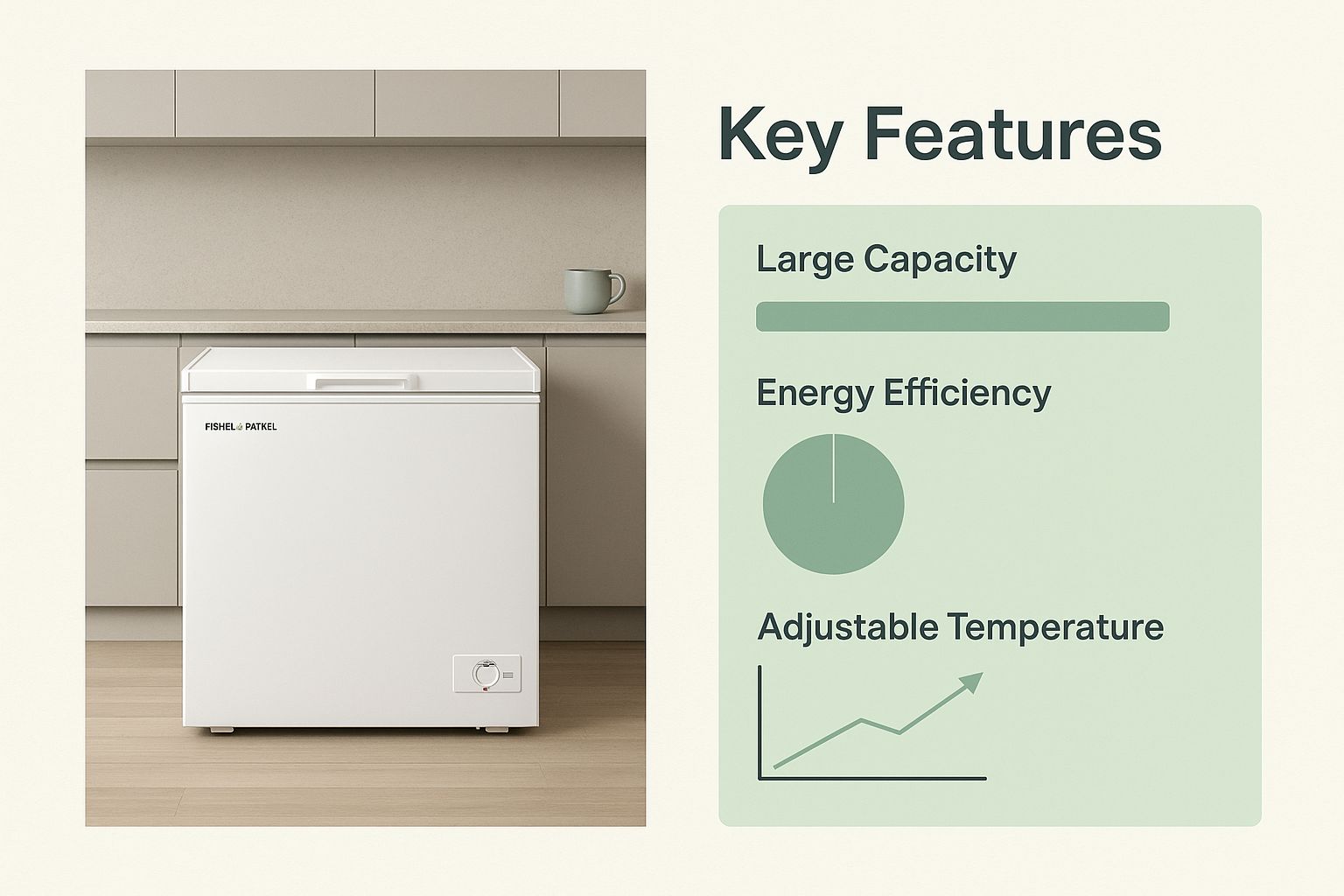
As you can see, today’s freezers are designed to be practical without looking out of place, blending clean aesthetics with genuinely useful features.
How to Calculate Your Freezer Needs
So, how do you turn abstract "litres" into something you can actually picture? A good rule of thumb I always suggest is to allow about 40-50 litres of freezer space per person in your household. This gives you a great starting point.
But that's just a baseline. Your own habits are what will really make the difference.
- Small Families & Couples (1-2 people): A freezer in the 100-200 litre range is usually the sweet spot. This gives you plenty of room for meal prepping, a few frozen pizzas, and stocking up when your favourite things go on sale, all without hogging too much space.
- Medium Families (3-4 people): You'll want to look at models between 200-380 litres. This capacity can comfortably handle the needs of a growing family, from bulk buys at the supermarket to having extra meals on hand for those chaotic weeknights.
- Large Families & Bulk Storers (5+ people): A freezer that’s 380 litres or more is going to be your best friend. This size is pretty much essential if you buy meat in bulk, have a big vegetable garden, or if you’re a keen hunter or fisher who needs to store large quantities at once.
A quick pro tip: it's always smarter to have a slightly larger, well-organised freezer than a smaller one that's crammed to the gills. When you over-pack a freezer, you block the airflow. This forces the motor to work overtime and drives up your power bill. For the best efficiency, aim to keep your freezer about 75-80% full.
To help you visualise the options, here's a quick comparison of some popular Fisher & Paykel models. This table breaks down their capacity and key features to make your choice a little easier.
Fisher & Paykel Chest Freezer Model Comparison
A side-by-side comparison of popular Fisher & Paykel chest freezer models, focusing on capacity, dimensions, and key features to help you select the perfect fit for your needs.
| Model Series | Capacity (Litres) | Dimensions (H x W x D) | Energy Star Rating | Key Features |
|---|---|---|---|---|
| HCF145 | 143 L | 845 x 730 x 555 mm | 2.5 Stars | Compact design, internal basket, easy-lift counterweight lid |
| HCF225 | 216 L | 845 x 940 x 555 mm | 2.5 Stars | Good mid-range capacity, one storage basket, front drainage outlet |
| HCF325 | 319 L | 845 x 1120 x 700 mm | 3 Stars | Large capacity, two baskets for organisation, interior light |
| HCF425 | 419 L | 845 x 1300 x 750 mm | 3 Stars | Very large capacity, multiple baskets, power-on indicator light, lockable |
| HCF525 | 519 L | 845 x 1650 x 750 mm | 3.5 Stars | Massive storage, premium interior light, multiple baskets, superior efficiency |
Hopefully, seeing the specs laid out like this gives you a clearer picture of how size and features line up across the range, helping you narrow down the perfect model for your home.
Beyond Family Size
While the number of people in your house is a big factor, your lifestyle often plays an even bigger role. To really dial in on the perfect size for your Fisher & Paykel chest freezer, ask yourself a few questions:
- How often do you shop? If you do big monthly trips to a bulk store like Costco, you’re going to need a lot more space than someone who just nips to the local supermarket every few days.
- Do you have a garden? Freezing your own fruit and veggies is a brilliant way to save your harvest, but it takes up a surprising amount of freezer real estate. A bumper crop of tomatoes or beans can fill a small freezer in no time.
- Are you a hunter or fisher? This is a huge one for many Kiwis. Storing large cuts of meat or whole fish absolutely requires a generously sized freezer, which is why you see so many of the largest models out in rural areas.
Thinking through these points will make sure you end up with an appliance that genuinely works for you. These same principles of matching capacity to your lifestyle are just as important when you're looking at other cooling appliances. If you found this useful, you might also be interested in our guide on the important things to consider when buying a fridge, as a lot of the same logic applies.
Decoding the Tech: What’s Under the Lid?
When you lift the lid on a Fisher & Paykel chest freezer, you’re looking at more than just a big, cold box. It’s the result of decades of smart engineering, all focused on making your life easier and keeping your food in prime condition for longer. Let’s pull back the curtain on some of this technology and translate the brochure-speak into real-world benefits you’ll actually notice.
These aren't just features for a sales pitch; they’re genuinely practical solutions to the everyday frustrations of food storage. Think of them as a toolkit designed to help you manage your frozen goods better, saving you time, money, and hassle down the track.
Clever Touches for Everyday Use
Fisher & Paykel really gets that a great appliance should adapt to you, not the other way around. This idea shines through in the small but significant details that just make things work better. You'll find these features quickly become things you can't imagine living without.
A perfect example is the counterweight lid. It might not sound like a big deal, but if you’ve ever tried to load groceries with one hand while propping up a heavy freezer lid with the other, you know the struggle. This clever design lets the lid stay open at any angle, freeing up both hands to pack and organise without it slamming shut on you.
Another brilliant touch is the bright internal LED lighting. No more rooting around in the icy darkness for that last bag of peas. The light fills the entire space so you can see exactly what you’ve got at a glance, which means less food gets forgotten and eventually wasted.
Smart Organisation and Keeping Food at its Best
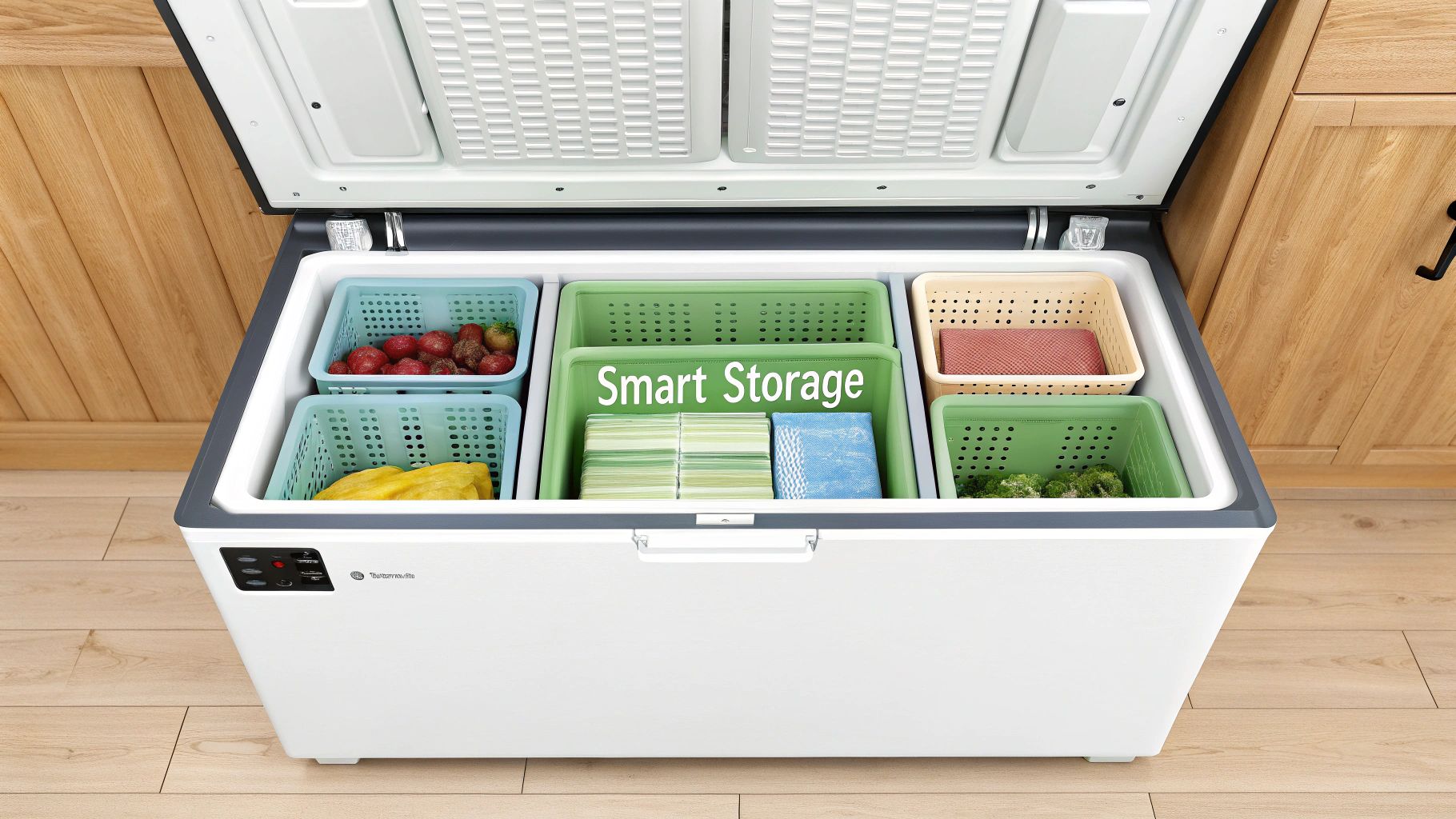
Let’s be honest, a deep chest freezer can easily turn into a chaotic jumble. Fisher & Paykel tackles this head-on with a system of removable, stackable wire baskets. These are essentially filing cabinets for your frozen food.
You can use them to group different items together, making everything a breeze to find and grab:
- Top Baskets: Perfect for things you use all the time, like ice cream, bread, or the kids' after-school snacks.
- Lower Baskets: Great for storing bulk meats, bags of frozen veggies, or batch-cooked meals.
- Open Space: The very bottom is ideal for those large, awkward items like the Christmas turkey or big cuts of meat.
This organised system doesn’t just save you from rummaging around; it also helps the freezer run more efficiently by letting cold air circulate properly. To see how this design philosophy carries across their entire range, you can dive deeper into our look at the Fisher & Paykel brand.
What is the 'Fast Freeze' Function?
The 'Fast Freeze' button is probably one of the most useful tools in your freezer's arsenal. When you get home with a big load of groceries, all that food is at room temperature. Putting it straight into the freezer raises the internal temperature, forcing the motor to work overtime. Fast Freeze gets ahead of this by rapidly dropping the temperature to its absolute coldest for a set period. This flash-freezes your new items, instantly locking in their nutrients, flavour, and texture.
A Focus on Efficiency and Sustainability
Beyond simple convenience, Fisher & Paykel puts a huge emphasis on energy efficiency—a critical factor for any appliance that runs 24/7. This is especially relevant here in New Zealand, where power bills and environmental impact are real considerations for many of us.
Their models are built to sip power without compromising on performance. The 373L Series 3 model, for instance, has a 3.5-star energy rating, using an average of just 299 kWh a year. Even the much larger 507L model maintains an efficient 3-star rating. This is achieved through top-notch insulation and the use of R600a, a modern refrigerant with a very low environmental impact. This focus means your Fisher & Paykel chest freezer doesn't just look after your food—it helps manage your power bills and lowers your household's carbon footprint. It’s a smart investment for both your wallet and the planet.
Understanding Energy Use and Running Costs
A Fisher & Paykel chest freezer is a quiet, hardworking appliance that runs 24/7 to keep your food frozen solid. Because it never gets a day off, its effect on your power bill is one of the most important factors to think about before you buy. Looking at its energy consumption isn't just about reading numbers on a sticker; it’s about understanding the real, long-term cost of owning it.
It's easy for energy efficiency to feel a bit abstract. Kilowatt-hours (kWh) and star ratings are handy, but what do they actually mean for your bank account? The trick is to turn those figures into an estimated yearly running cost. This gives you a much clearer idea of how different models will impact your household budget over the freezer's lifetime.
Decoding the Energy Star Rating
When you see an Energy Star label on an appliance here in New Zealand, just think of it as a simple report card for efficiency. The more stars a freezer has, the less power it needs to do its job, which means lower electricity bills for you. A half-star difference might not seem like much, but over ten or more years of constant use, those savings really start to stack up.
Fisher & Paykel has put a lot of work into making their chest freezers exceptionally efficient. They’ve managed this through a combination of top-notch insulation to trap the cold and clever compressor technology that only works as hard as it has to.
This focus on efficiency isn't just a marketing gimmick; it's central to good appliance design today. Picking a model with a higher star rating is one of the simplest ways to lower your home's running costs and shrink your environmental footprint.
To get a better handle on how these ratings work for all your appliances, you can check out our detailed Energy Star rating NZ guide. It breaks down everything you need to know to make smarter purchases for your home.
The Technology Behind the Savings
So, what exactly makes a new Fisher & Paykel chest freezer so much more efficient than the old beast that might be humming away in your garage right now? The magic is in a few key technical improvements working together to keep power use to a minimum.
- Advanced Insulation: Picture a really high-quality chilly bin. Thicker, denser foam insulation inside the walls and lid forms a strong barrier against the room's temperature. This means the motor doesn't have to switch on as often to keep things frosty inside.
- Eco-Friendly Refrigerant: Fisher & Paykel uses R600a refrigerant, a gas with a very low Global Warming Potential (GWP). Not only is it better at transferring heat than the refrigerants used in older models, but it's also much gentler on the environment.
- Airtight Seal: That rubber seal, or gasket, around the lid plays a massive role. A perfect, tight seal stops cold air from leaking out and warm air from sneaking in—one of the biggest energy-wasters for any freezer.
These design decisions are part of a bigger shift across the New Zealand appliance market. As the country's main manufacturer, Fisher & Paykel's focus on efficiency has had a real impact on lowering national household electricity use. This commitment means your new freezer isn't just a purchase; it's a smart, sustainable investment for the years ahead.
Smart Installation and Placement Tips
Where you end up putting your new Fisher & Paykel chest freezer makes a huge difference to how well it runs and how long it lasts. It might seem like a small detail, but getting the placement right from day one is your ticket to better efficiency and years of trouble-free performance. It's a bit like setting the foundations for a house—a little care at the start saves you from big headaches down the line.
The best home for your freezer is a dry, level, and well-ventilated spot that doesn't suffer from wild temperature changes. Think garages, laundries, or a decent-sized pantry. Just make sure to keep it away from direct sunlight or anything that generates heat, like an oven or hot water cylinder. Placing it next to a heat source forces the motor to work overtime just to stay cold, which you'll definitely see on your power bill.
Why Ventilation is Non-Negotiable
Giving your freezer some breathing room isn't just a suggestion; it's essential. A chest freezer cools itself by drawing heat out from the inside and pushing it out through coils in its outer walls. If air can't circulate freely around it, that heat gets trapped, and the compressor has no choice but to run constantly.
Honestly, this is one of the most common and easily fixed mistakes people make. An overworked motor not only chews through more power but can also seriously shorten the life of your appliance.
As a rule of thumb, here’s the space you should aim for:
- Sides: At least 10 cm of clear space on both sides.
- Back: A minimum of 10 cm between the back of the freezer and the wall.
- Top: Enough clearance to open the lid all the way without it bumping into anything.
Following these simple guidelines ensures your freezer has the airflow it needs to run at its best. If you're still weighing up your options, our guide on the top freezer picks for NZ homes has some great advice and comparisons.
The Importance of a Level Surface
Here’s another critical step: make sure your freezer is sitting perfectly level. If it’s on a tilt, even a slight one, the lid can’t create a proper, airtight seal against the cabinet.
A poor seal is an energy efficiency killer. Cold air leaks out, warm air seeps in, and you end up with frost build-up. The freezer then has to work that much harder just to maintain its temperature.
Grab a spirit level and check it from front-to-back and side-to-side. Thankfully, most Fisher & Paykel models have adjustable feet, so it’s easy to tweak the height until it’s perfectly stable and the lid closes with a satisfying, uniform thud.
Your Initial Start-Up Checklist
Once your freezer is in its new home, just run through this quick list for a smooth start:
- Clean the Interior: Before you even think about plugging it in, give the inside a good wipe-down with some warm water and a bit of baking soda. This gets rid of any dust from the factory and helps neutralise any odours.
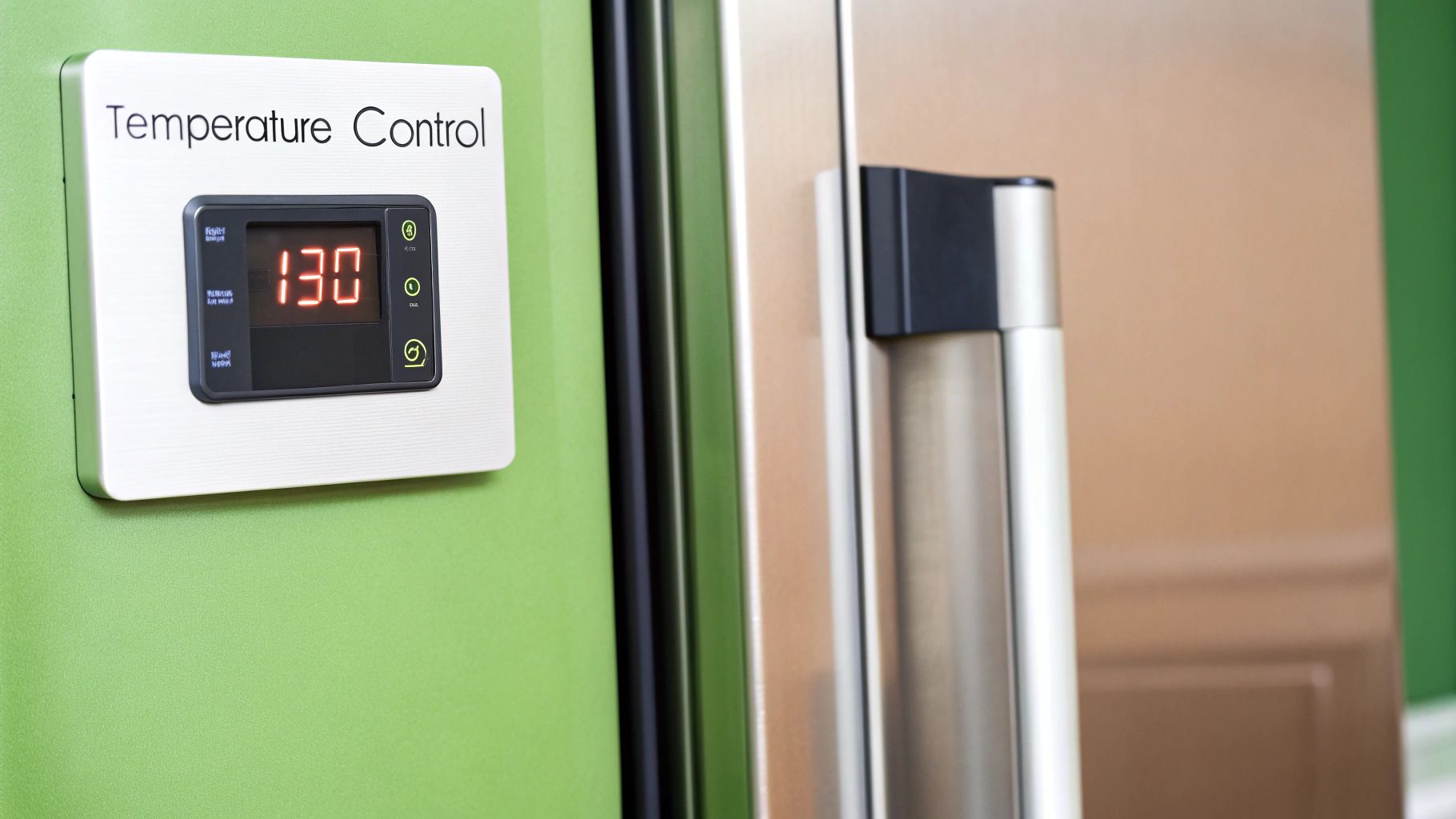
- Plug It In and Wait: Switch the freezer on and turn the temperature dial to your preferred setting.
- Let It Settle: This is the important part. Let the freezer run empty for at least 3-4 hours before you put any food inside. This gives it plenty of time to get down to a stable, deep-freeze temperature.
- Load It Gradually: When it's time to stock it up, try not to cram everything in at once. If you're adding a lot of food, do it in batches. This prevents the internal temperature from spiking, which makes the freezer work harder than it needs to.
Right, let's get your Fisher & Paykel chest freezer running smoothly for the long haul. A bit of simple, regular care makes a massive difference, not just to how well it works, but to its lifespan and your power bill. Think of it less as a chore and more as a smart way to protect your investment and the food inside.
These aren't complex tasks. They’re just quick, practical steps that keep your freezer in top shape, saving you from the hassle and cost of a breakdown down the track.
Why Defrosting is a Must-Do Job
One of the most important things you can do for your freezer is defrost it. It might seem like a bit of a pain, but there’s a really solid reason for it. As ice builds up inside, it acts like a thick blanket, insulating the freezer from its own cooling system.
The thicker that ice gets, the harder the motor has to work to keep everything frozen solid. This constant extra effort not only puts more wear and tear on the appliance but also makes your electricity meter spin faster.
A layer of frost just 6-7mm thick can jack up your freezer's energy use by a surprising 15-20%. So, defrosting isn't just about freeing up space—it's about keeping your running costs down and the freezer healthy.
For most models, tackling this once or twice a year is perfect. Or, just do it whenever you notice the ice has reached that 6-7mm thickness. It’s a small job with a big payoff.
A Simple Guide to Cleaning and Care
Keeping the inside of your freezer clean is basic hygiene, but it also helps it run better. A quick clean stops funky smells from developing, slows down that pesky ice build-up, and gives you a chance to spot any potential problems early.
Here’s an easy routine to follow:
- Empty and Unplug: First things first, get all your frozen goods out and pop them into chilly bins with some ice packs to keep them safe. Then, unplug the freezer from the wall—safety first!
- Let it Defrost: Just open the lid and let the ice melt naturally. It’s a good idea to lay some old towels around the base to catch any water. Whatever you do, don't use a knife or any sharp tools to chip away at the ice. You could easily puncture the freezer wall and cause serious, expensive damage.
- Wipe it Down: Once all the ice has melted, mix up a simple cleaning solution. Two tablespoons of baking soda in about a litre of warm water works wonders. It cleans brilliantly and gets rid of any odours without leaving behind harsh chemical smells.
- Dry it Out: Grab a soft cloth and give all the inside surfaces a thorough wipe. Make absolutely sure it’s completely dry before you plug it back in. Any leftover moisture will just turn straight back into frost, and you’ll be back where you started.
The Final Checks: Seals and Airflow
A couple of final checks will have your Fisher & Paykel chest freezer running at its absolute best. These little details can have a surprisingly big impact on how efficiently it operates.
Inspect the Lid Seal That rubber gasket running around the edge of the lid is crucial. It’s the barrier that keeps warm air out. If it’s loose, cracked, or damaged, your freezer has to work overtime to stay cold, wasting energy and causing more frost.
Give it a quick inspection once a year. Run your finger along the seal, feeling for any spots that are hard, brittle, or pulling away. A classic trick is to close the lid on a banknote; if you can slide it out with no resistance, the seal probably needs a good clean or even replacing.
Organise for Better Airflow It turns out that how you pack your freezer actually matters. Good organisation isn’t just about finding things easily; it helps cold air circulate properly, keeping everything evenly frozen.
- Use the Baskets: This is what they’re for! Keep the things you grab most often in the top baskets for quick access.
- Don't Overpack: A freezer that’s about 75-80% full is the sweet spot. It's full enough to hold its temperature well but still has enough room for air to move around.
- Group Similar Items: Put all your meats in one area, veggies in another, and so on. This means less rummaging around with the lid open, which helps keep the cold air in.
Got a Question? We've Got Answers
Once your new appliance is settled in and quietly doing its job, you're bound to have a few practical questions pop up. It happens to everyone. Here, we tackle some of the most common queries we get about Fisher & Paykel chest freezers, giving you clear, simple answers for total peace of mind.
How Often Should I Defrost My Freezer?
For any manual defrost freezer, the rule of thumb is to tackle the job when the ice gets about 6-7mm thick – roughly the width of a pencil. For most Kiwi families, this usually means defrosting once or twice a year. It might feel like a chore, but it’s one of the best things you can do for your freezer's health.
Think of that thick layer of ice as an unwanted winter duvet wrapped around the inside of your freezer. It actually insulates the interior from the cooling elements, forcing the motor to run harder and longer just to keep things cold.
Regular defrosting isn't just about freeing up space. It's about efficiency. An ice-free freezer uses less power, which is something you'll definitely notice on your electricity bill.
Is It Normal for the Outside of the Freezer to Feel Warm?
Yes, absolutely. It can be a bit of a surprise the first time you feel it, but it's completely normal for the outer walls of your Fisher & Paykel chest freezer to feel warm, and sometimes even hot to the touch.
This is actually a pretty clever bit of engineering. The system that pulls heat out of the freezer is built right into the walls. By warming the exterior, the design prevents condensation from forming on the outside, which helps stop rust and moisture damage down the track. You'll likely notice the warmth most when:
- You've just plugged the freezer in for the first time.
- You've just loaded it up with a big shop.
- The ambient temperature in the room is high, like on a hot summer day.
As long as you've left enough breathing room around the unit for ventilation (like we talked about earlier), this warmth is just a sign that everything is working as it should.
What Should I Do with My Food During a Power Cut?
A power cut is always a pain, but your freezer is designed to ride it out. The number one rule is to keep the lid shut. Seriously. Every time you open it, you let that precious cold air out, and the clock starts ticking much faster on your frozen food.
A full Fisher & Paykel chest freezer is incredibly well-insulated. With the lid kept firmly closed, it can keep food safely frozen for 24 to 48 hours without any power.
When the power comes back on, it’s time for a quick inspection:
- Check the Food: Open the lid and have a look at the contents.
- Look for Ice Crystals: If your food still has ice crystals on it, it’s generally safe to refreeze.
- Check for Thawing: If items have thawed completely—especially things like meat, fish, or dairy—you shouldn't refreeze them. Your safest option is to cook them right away. If you're in any doubt, it's always best to throw it out.
Ready to find the perfect freezer for your home? At Folders, we have a fantastic selection of Fisher & Paykel chest freezers to suit any space and budget. See what's available and get the peace of mind that comes with a top-quality appliance. Shop the range at Folders.co.nz today!