

Your Haier Clothes Dryer NZ Buying Guide
Diving into the world of clothes dryers can feel a bit overwhelming, but figuring out which Haier clothes dryer in NZ is right for you is probably easier than you think. Haier has a solid lineup built specifically for Kiwi homes, offering a great mix of energy efficiency, performance, and price to suit different households all over the country.
Finding Your Perfect Haier Dryer Match in NZ
Picking a new appliance is a big deal. For many of us here in New Zealand, Haier has become a trusted name in the laundry, known for practical gear that just gets the job done. Whether you’re in a small city apartment or a sprawling family home, chances are there's a Haier dryer that fits your space and your ever-growing laundry mountain.
The first step is getting to know the main types of dryers Haier makes. Each one dries your clothes differently, which has a knock-on effect on where you can put it, how much it costs to run, and even how gentle it is on your clothes. It’s a bit like choosing a car: you need to decide if you're after the fuel economy of a hybrid, the rugged flexibility of an SUV, or the no-fuss power of a classic sedan.
Quick Guide to Haier Dryer Types
To help you get your head around the options, here's a quick comparison of the three main technologies Haier uses. This should make it much easier to see which one aligns with your home and laundry habits.
| Dryer Type | Best For | Energy Efficiency | Installation Needs |
|---|---|---|---|
| Vented Dryer | Budget-conscious buyers with easy outdoor access. | Standard | Requires external venting through a wall or window. |
| Condenser Dryer | Homes and apartments without external venting options. | Good | Plugs in anywhere; needs its water tank emptied. |
| Heat Pump Dryer | Energy-savers and those with delicate fabrics. | Excellent (Highest) | Plugs in anywhere; the most flexible option. |
As you can see, your choice really comes down to balancing your home's setup with your desire for energy savings.
The Three Main Dryer Technologies Explained
So, what do those terms actually mean? Let's break them down without the confusing jargon. Your decision will likely land on one of these three core technologies.
- Vented Dryers: These are the classic, no-frills workhorses. They’re often the most affordable to buy outright and work simply by pushing the hot, damp air from your clothes outside through a ducting hose.
- Condenser Dryers: A fantastic all-rounder, especially for homes where you can't just stick a hose out the window. They work by cooling the moist air and collecting the water in a container (which you just empty after a cycle) or draining it away. This gives you way more freedom on where to place it.
- Heat Pump Dryers: This is the top-tier choice for energy efficiency. Think of it as the smart recycler of the dryer world. It reheats and reuses the air in a closed-loop system, which means it can dry your clothes at lower, gentler temperatures while slashing your power bill.
This diagram gives you a clear visual of how Haier's dryer range is structured here in New Zealand.
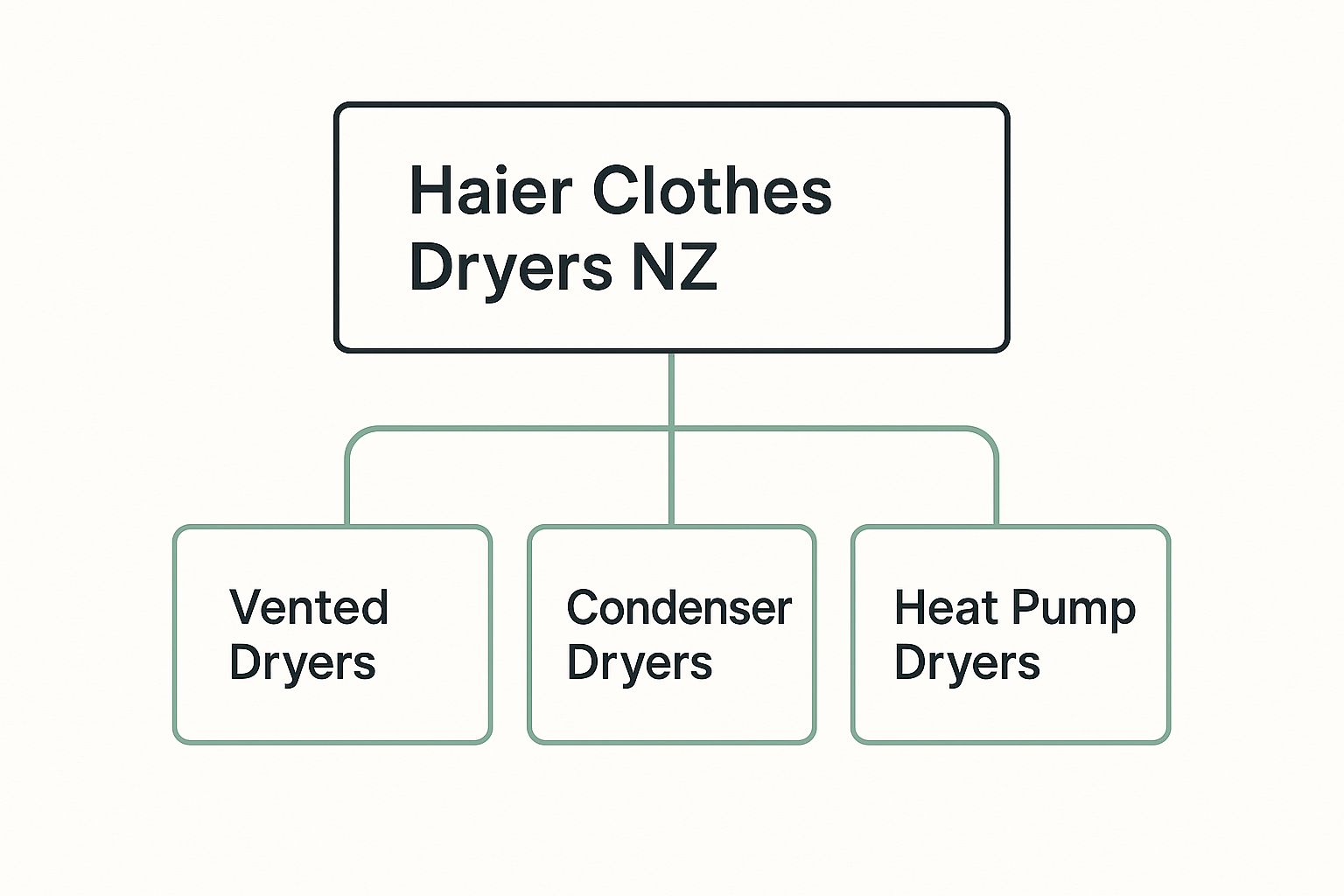
As you can see, all three technologies sit under the Haier umbrella, giving you distinct options based on what you value most—be it budget, flexibility, or long-term savings.
A Strong Local Connection
Haier's impressive foothold in the local market is no accident. The brand's presence here really took off after it acquired our own iconic Kiwi brand, Fisher & Paykel. That move gave Haier access to decades of local design knowledge and a robust distribution network, cementing its place in homes across New Zealand.
Today, Haier holds a market share of over 25% in Australia and New Zealand, a figure that speaks volumes about its focus on making appliances that Kiwis actually want and use.
The real win for us as consumers is that Haier has shaped its appliance range to fit the New Zealand lifestyle. It's a blend of global technology with a genuine understanding of what a Kiwi household really needs from a dryer.
Ultimately, choosing the right Haier clothes dryer in NZ is all about matching the machine's features to your daily routine. If you want to dig a bit deeper before making a final call, our comprehensive clothes dryer buying guide for NZ offers even more detailed comparisons and tips to help you choose with complete confidence.
How Haier Dryer Technology Actually Works
Trying to figure out what’s happening inside a clothes dryer can feel a bit technical, but the concepts are surprisingly straightforward. When you're looking at a Haier clothes dryer in NZ, you're basically choosing between three different ways of getting moisture out of your clothes.
Each technology has its own clever method for doing the job. This directly affects everything from your power bill and where you can put the machine, to how well it looks after your favourite garments. Let's pull back the curtain on these technologies—minus the confusing jargon—to see how they work and what that means for your laundry day.
Heat Pump Dryers: The Energy Recyclers
Think of a heat pump dryer as the clever offspring of a dehumidifier and a traditional dryer. It’s the most advanced and energy-efficient technology Haier offers because instead of constantly generating new heat, it recycles warm air in a closed loop.
Here’s a simple look at how it gets the job done:
- Warm Air Circulates: The dryer warms up air and tumbles it through your wet clothes, allowing the air to absorb the moisture.
- Moisture is Removed: This now-damp air then passes over a cold evaporator coil. Just like a cold glass on a humid day, this causes the moisture in the air to condense into water, which is collected in a tank or drained away.
- Heat is Recycled: Here's the magic part. The heat that was just removed from the air is captured and pumped back to the other side to reheat the now-dry air. This warm, dry air is then sent back into the drum to start the process all over again.
This continuous recycling uses far less electricity—often less than half that of a standard vented dryer. For any Kiwi household keeping an eye on rising power prices, this makes it a brilliant long-term investment.
Because heat pump dryers operate at lower temperatures, they're much gentler on your clothes. This helps your delicate woollens and activewear last longer, preventing the shrinking and fabric damage that high heat can cause.
This gentle, efficient approach is a real game-changer for many families. If you want to dive deeper, you can learn more about how a heat pump dryer provides energy-efficient laundry for Kiwi homes in our detailed guide.
Condenser Dryers: The Self-Contained Systems
A condenser dryer is a fantastic middle-ground option, offering incredible flexibility for installation. It’s a completely self-contained system that deals with its own moisture, meaning you don't need to vent it outside. This makes it perfect for apartments, internal laundries, or any home where cutting a hole in the wall just isn't practical.
It works by turning the hot, steamy air from your clothes back into water. The warm, moist air is funnelled through a heat exchanger (the condenser), where it cools down rapidly. This causes the water vapour to condense back into liquid, which is collected in a removable reservoir that you simply empty every few loads. Some models even have a hose for plumbing it directly into a sink or laundry drain.
While not quite as energy-frugal as a heat pump model, a Haier condenser dryer is still a big step up in efficiency from a traditional vented dryer and gives you the freedom to place it almost anywhere you have a power point.
Vented Dryers: The Fast and Straightforward Classic
The vented dryer is the original and most straightforward design—the classic workhorse of the laundry room. It's well-known for being affordable to buy and for drying clothes very quickly.
The process couldn't be simpler:
- It draws in air from the laundry room.
- An element heats the air, which is then tumbled through the wet clothes.
- The hot, damp air is then blown outside through a flexible ducting hose.
This direct approach often means faster drying times. The trade-off, however, is energy efficiency, as all that heated air is simply pumped out of your home. You also need to install it near a window or an external wall to run the vent through, which can limit your placement options. For many Kiwis, though, the low upfront cost and speedy performance make a Haier vented dryer a very practical choice.
Understanding Key Haier Dryer Features
A modern Haier clothes dryer is a far cry from the simple hot-air boxes of the past. These days, they’re packed with clever technology designed to make your laundry day easier, protect your clothes, and even trim down your power bill. But let's be honest, marketing terms like "Hybrid Boost" and "Sensor Drying" can sound a bit like jargon.
So, let's break down what these features actually do in the real world. We'll look at the key technologies you'll find on a Haier clothes dryer in NZ and translate them into practical benefits, helping you pick a machine with features you'll actually use and love.
The Power of Choice with Hybrid Boost
One of the smartest innovations you'll see on some Haier heat pump dryers is Hybrid Boost technology. Think of it as giving you complete control over your drying, allowing you to prioritise either speed or energy savings. It's a brilliant feature for the unpredictable pace of Kiwi life.
So, how does it work?
- Eco Mode: When time isn't a factor, the Eco setting runs the heat pump at its most efficient. It uses a lower, gentler temperature to dry your clothes, which is fantastic for your fabrics and delivers the best possible energy savings.
- Speed Up Function: For those mad dashes when you need a school uniform or work shirt dried now, the Speed Up function brings a small heating element into play. It works in tandem with the heat pump to get your clothes dry much faster, giving you the kind of speed you'd expect from an old-school vented dryer but without the eye-watering energy use.
This flexibility means you no longer have to choose between a fast dryer and an efficient one—you get the best of both worlds in a single appliance. It’s the perfect compromise for a busy household.
Sensor Drying to Protect Your Clothes
Have you ever pulled clothes from the dryer only to find them feeling stiff, shrunken, or "cooked"? That’s the classic sign of over-drying, a common issue that not only ruins your garments but also wastes a surprising amount of power. Haier’s Sensor Drying feature is your built-in safeguard against this.
Sensor Drying is like having a laundry expert inside your machine. It uses intelligent sensors to continuously monitor the exact moisture level of your clothes, automatically stopping the cycle the moment they’re perfectly dry.
This wonderfully simple tech prevents over-drying and delivers some big wins:
- Protects Your Garments: By avoiding unnecessary heat, it helps extend the life of your favourite clothes and prevents that dreaded shrinking.
- Saves Energy and Money: The dryer only runs for as long as it absolutely needs to, cutting down energy use compared to a basic timed cycle.
- Delivers Better Results: Your clothes come out feeling softer and are often less wrinkled, which means less time spent slaving over an ironing board.
Specialised Cycles for Every Fabric
Gone are the days of just having 'hot' and 'warm' settings. Today’s Haier dryers come with a whole menu of specialised cycles designed to give everything in your wardrobe the specific care it needs. Knowing what these do helps you get the most out of your machine. Choosing the right appliance is a big decision, and you can explore more general tips you need to know when buying appliances in our dedicated guide.
Here are some common cycles you’ll find:
- Refresh Cycle: An absolute game-changer. This uses a quick burst of steam or warm air to de-wrinkle and deodorise dry clothes that have been sitting in the closet. It's perfect for quickly freshening up a shirt before you head out.
- Delicate Cycle: This setting uses very low heat and gentle tumbling action to safely dry sensitive items like silk, lingerie, or anything with fine detailing.
- Wool Cycle: Certified by Woolmark, this cycle is precisely calibrated to dry your machine-washable woollens without causing felting or shrinking.
- Sports Cycle: Designed for modern activewear, this cycle effectively dries those technical, moisture-wicking fabrics without damaging their performance with too much heat.
Many of the more advanced models also offer Wi-Fi connectivity, letting you control and monitor your drying right from your phone—a genuinely handy feature for a modern, busy lifestyle.
Calculating Energy Use and Running Costs

It’s easy to focus on the price tag when you’re buying a new dryer, but the real cost of owning one shows up on your power bill, month after month. For most Kiwi households, electricity prices are a real concern, so understanding a dryer's running costs isn't just a 'nice to have'—it's essential for making a smart financial choice.
Let's break down the numbers and show you exactly how to work out the long-term expense of a Haier clothes dryer in NZ. It's much simpler than you might think, and doing this quick calculation could easily save you hundreds, if not thousands, of dollars over the life of your appliance.
Decoding The Energy Rating Label
Every new dryer sold in New Zealand has to have the official Energy Rating Label stuck on it. Think of this bright sticker as your best mate when you're comparing models. It gives you two crucial bits of info at a glance.
The first is the star rating. More stars mean better efficiency—simple. But the figure you really want to pay attention to for calculating your actual costs is the kilowatt-hour (kWh) consumption.
This number, usually written as "XXX kWh per year," is an estimate of how much power the dryer will use based on one standard load, every day, for a year. This is the key to figuring out real-world running costs.
A Practical Cost Comparison
To put this into perspective, let's compare two different types of Haier dryers: a super-efficient heat pump model versus a standard vented one. This example really shines a light on how dramatic the difference in running costs can be.
- Haier Heat Pump Dryer: An impressive 8-star rating, using around 150 kWh per year.
- Haier Vented Dryer: A more basic 2-star model, which chews through about 550 kWh per year.
Now, let's turn those kWh figures into dollars and cents. The average electricity rate across New Zealand is about 30 cents per kWh, but it’s always a good idea to check your latest power bill for your specific rate.
The formula is straightforward: (kWh per year) x (your electricity rate) = Annual Running Cost.
Plugging in our numbers:
- Heat Pump Dryer Cost: 150 kWh x $0.30 = $45 per year
- Vented Dryer Cost: 550 kWh x $0.30 = $165 per year
In just one year, the heat pump model saves you $120 on power. Stretch that out over the typical 10-year lifespan of a dryer, and you're looking at a huge saving of $1,200. All of a sudden, the higher purchase price of the heat pump dryer starts to look like a very shrewd investment.
This kind of long-term thinking is driving a major shift in the market. Globally, the demand for energy-efficient dryers is on the rise, and this is especially true here in New Zealand. Haier's focus on innovative, cost-effective technology is perfectly in tune with what Kiwi families are looking for.
Balancing Investment With Savings
Ultimately, your decision comes down to balancing the upfront cost with the ongoing savings. A vented dryer is cheaper to buy today, but its higher running costs mean you'll pay a lot more to run it over the years.
On the other hand, a Haier heat pump dryer needs a bigger investment initially, but its fantastic energy efficiency delivers significant savings every year. It often pays back the price difference and then some. By using the Energy Rating Label, you can confidently work out which Haier clothes dryer NZ model gives you the best bang for your buck, both for your budget and your laundry routine.
Getting Your Haier Dryer Set Up and Keeping It Happy
So, you’ve brought your new Haier dryer home. Brilliant! But getting the best performance isn't just about the model you chose; it’s also about where you put it and how you look after it. A bit of care goes a long way, ensuring your dryer runs efficiently and lasts for years.
The good news? It’s incredibly straightforward. Let's walk through how to set up your specific Haier model and then cover the simple habits that will keep it running like a dream.
Setting Up Your Haier Dryer
How you install your Haier clothes dryer in NZ really comes down to which type you've bought. Some are as simple as finding a spot and plugging them in, while others need a little more planning.
Heat Pump and Condenser Dryers
These models are the kings of convenience, especially if you're renting or have an internal laundry without easy outdoor access. Installation is genuinely 'plug and play'.
- Find a good spot: All you need is a stable, level surface with a bit of space around it for air to circulate.
- Plug it in: They use a standard power outlet, no special wiring needed.
- Manage the water: For condenser dryers, you can either empty the water tank after a load or two, or hook up the optional drainage hose to a nearby sink or standpipe for a 'set and forget' solution.
And that's pretty much it. Because they don't pump moist air into your laundry, you can place them just about anywhere. If you’re still curious about the technology, our guide on if heat pump dryers are worth it in NZ breaks down all the long-term benefits.
Vented Dryers
Vented dryers are fantastic, fast-working machines, but they have one non-negotiable requirement: venting. They push hot, damp air out of the drum, and that air has to go somewhere. Letting it vent directly into your laundry is a recipe for condensation, which can lead to mould and mildew problems.
You’ll need to connect the flexible hose that comes with the dryer to the outside, either through a window or an external wall. A simple venting kit from a hardware store will give you a professional, tidy finish. It’s a manageable job for a confident DIYer and crucial for the dryer to work properly.
Your Simple Maintenance Checklist
Think of your dryer like your car—a little routine maintenance keeps it performing at its peak. These quick jobs barely take a minute but make a world of difference to your machine's efficiency, safety, and lifespan.
A quick tip from the experts: Neglecting basic maintenance, especially cleaning the lint filter, is the single biggest reason dryers underperform or become a safety risk. A tiny bit of effort here pays off massively in performance and peace of mind.
Here’s a simple checklist to keep your Haier dryer in top condition.
Haier Dryer Maintenance Checklist
A few simple, regular tasks will keep your Haier dryer performing efficiently and safely for years to come.
| Maintenance Task | Frequency | Why It Matters |
|---|---|---|
| Clean the Lint Filter | After every single load. | This is the most important job! A clogged filter kills airflow, forcing your dryer to work harder, use more energy, and take ages to dry anything. It's also a serious fire hazard. |
| Empty the Water Reservoir | As needed (after 1-2 loads). | Specific to condenser and heat pump models. If the tank gets full, the dryer will pause until it's emptied. Keep it clear for seamless drying. |
| Wipe Down the Drum | Monthly. | Use a damp cloth to wipe out any residue from fabric softeners or dryer sheets. This keeps the drum clean and your clothes smelling fresh. |
| Check External Vents | Every 6 months. | For vented models, make sure the outside vent cap is free from leaves, lint, or even nesting birds. A clear path out ensures strong airflow. |
Following these simple steps is the best way to protect your investment. It ensures your Haier dryer runs safely, saves you money on your power bill, and delivers perfectly dry laundry every time you need it.
Your Common Haier Dryer Questions Answered
So, you've looked at the features and the technology, but a few practical questions are probably still swirling around. That’s perfectly normal. When you’re about to invest in a major appliance for your home, you want to be sure you’ve got all the facts.
To help you get over that final hurdle with confidence, we’ve put together answers to some of the most common questions we hear from Kiwis about buying a Haier clothes dryer in NZ. Think of this as the final piece of the puzzle.
Can I Stack a Haier Dryer on Top of My Washing Machine?
Absolutely! This is one of the most common space-saving tricks in modern Kiwi laundries, and Haier designs its appliances with exactly this in mind. Most Haier front-load dryers are built to be stacked securely on top of a matching Haier front-load washing machine.
There’s one crucial step you can’t skip, though: you must use a genuine Haier stacking kit.
This isn't just an optional extra; it's a vital piece of safety gear. The stacking kit is a sturdy frame that locks the dryer to the washer, stopping it from vibrating or creeping forward during a spin cycle. Trying to stack them without a kit is incredibly risky and could cause the dryer to fall.
Before you commit, just double-check that your chosen washer and dryer models are compatible with each other and with the specific stacking kit you plan to use.
Are Haier Heat Pump Dryers Noisy to Run?
This is a big one, especially if your laundry is nestled close to your living room or bedrooms. The good news is that Haier heat pump dryers are engineered to be surprisingly quiet. They generally operate at a sound level of around 65 to 67 decibels.
To give you a real-world comparison, that's about the same volume as a quiet conversation or a modern dishwasher running in the background. You’ll hear a low, steady hum from the compressor, but it’s a world away from the rattling and rumbling of older vented models. Their quiet performance makes them a brilliant choice for laundries inside the main part of the house, or even tucked away in a cupboard.
How Long Does a Haier Heat Pump Dryer Take to Dry a Load?
It's true that a heat pump dryer cycle generally takes a bit longer than a traditional vented one. This is completely by design. Because they use much lower temperatures to save energy and be kinder to your clothes, a typical cycle can take anywhere from two to three hours.
This slow-and-steady approach is what protects your favourite garments from heat damage and shrinkage. But Haier gets that sometimes, life demands a bit more speed.
Many of the latest Haier heat pump models feature a Hybrid Boost function. This clever setting gives you the choice: run a faster cycle that uses a little more energy, or stick with the ultra-efficient standard mode. It’s the best of both worlds.
This flexibility means you can enjoy maximum energy savings for your everyday loads but still have a speed option up your sleeve for those times you’re in a rush.
What Warranty Comes with a Haier Dryer in New Zealand?
When you buy a new Haier dryer here in New Zealand, you can rest easy knowing it comes with solid backup. Haier appliances are typically sold with a standard 2-year manufacturer's warranty, which covers both parts and labour for any manufacturing faults.
This gives you great peace of mind that your new appliance is protected. It’s always smart to confirm the specific warranty details with the retailer when you buy, just in case there are any special promotions or extended warranty offers available. For a deeper dive into the brand and its presence here, you can learn more about Haier NZ in our dedicated article.
This level of support, paired with smart features and energy-saving tech, is what makes a Haier dryer such a reliable and sensible choice for any New Zealand home. You're not just buying an appliance; you're investing in a solution that truly fits the Kiwi lifestyle.
Ready to find the perfect Haier dryer for your home? Explore the full range at Folders and enjoy everyday low prices and expert advice.