

Food Processor vs Blender The Ultimate Kitchen Guide
Let's get straight to the point: the real difference between a food processor and a blender comes down to what you want to achieve in the kitchen.
Think of a food processor as your ultimate prep assistant. It’s built to handle the tough, time-consuming jobs like chopping, shredding, and mixing dense ingredients, usually with very little liquid. A blender, on the other hand, is all about creating silky-smooth textures. It’s specifically designed to liquefy solids, making it the go-to for drinks, soups, and purées.
Essentially, your choice hinges on a simple question: are you mostly preparing ingredients for a meal, or are you creating liquid-based dishes?
Your Quick Answer: Food Processor or Blender?
It’s easy to get bogged down in specs and features, but the fundamental difference between these two appliances lies in their design and, therefore, their purpose. A food processor has a wide bowl and a set of interchangeable blades, giving it incredible versatility. In contrast, a blender features a tall, narrow jar with a fixed blade at the bottom, engineered to create a powerful vortex.
These two kitchen staples are big players in the small appliance market, which was valued at a massive USD 29.09 billion in 2024 and continues to grow. While specific New Zealand data can be hard to come by, global trends give us a clear picture. Full-sized food processors, for instance, command a dominant 46.8% market share in their category, showing just how much home cooks rely on their multi-tasking abilities.
Here’s the easiest way to think about it: blenders are for liquids, and food processors are for solids. A blender pulls ingredients down into a swirling vortex for a smooth finish, while a food processor uses its wide bowl and sharp blades to chop, slice, or mix ingredients quickly and efficiently.
Getting this core difference right is the first step. For more guidance on making a smart purchase, have a read of our tips you need to know when buying appliances.
To make the comparison even clearer, here’s a quick breakdown of where each appliance truly shines.
At a Glance: Food Processor vs Blender
This simple table breaks down the core purpose and best uses for each appliance, helping you see exactly where they fit in your kitchen.
| Feature | Food Processor | Blender |
|---|---|---|
| Primary Function | Chopping, shredding, slicing, mixing, and kneading | Liquefying, puréeing, emulsifying, and crushing ice |
| Best For | Labour-intensive prep work; creating texture | Smooth liquids like smoothies, soups, and sauces |
| Liquid Handling | Requires minimal liquid; can leak with large amounts | Designed specifically to contain and process liquids |
| Blade Design | Interchangeable S-blades, discs for slicing/shredding | Fixed, multi-pronged blade assembly at the base |
As you can see, while they might look similar, their strengths are in completely different areas. One is about preparation and texture, while the other is all about creating smooth, drinkable, or pourable results.
Comparing Core Design and Mechanics
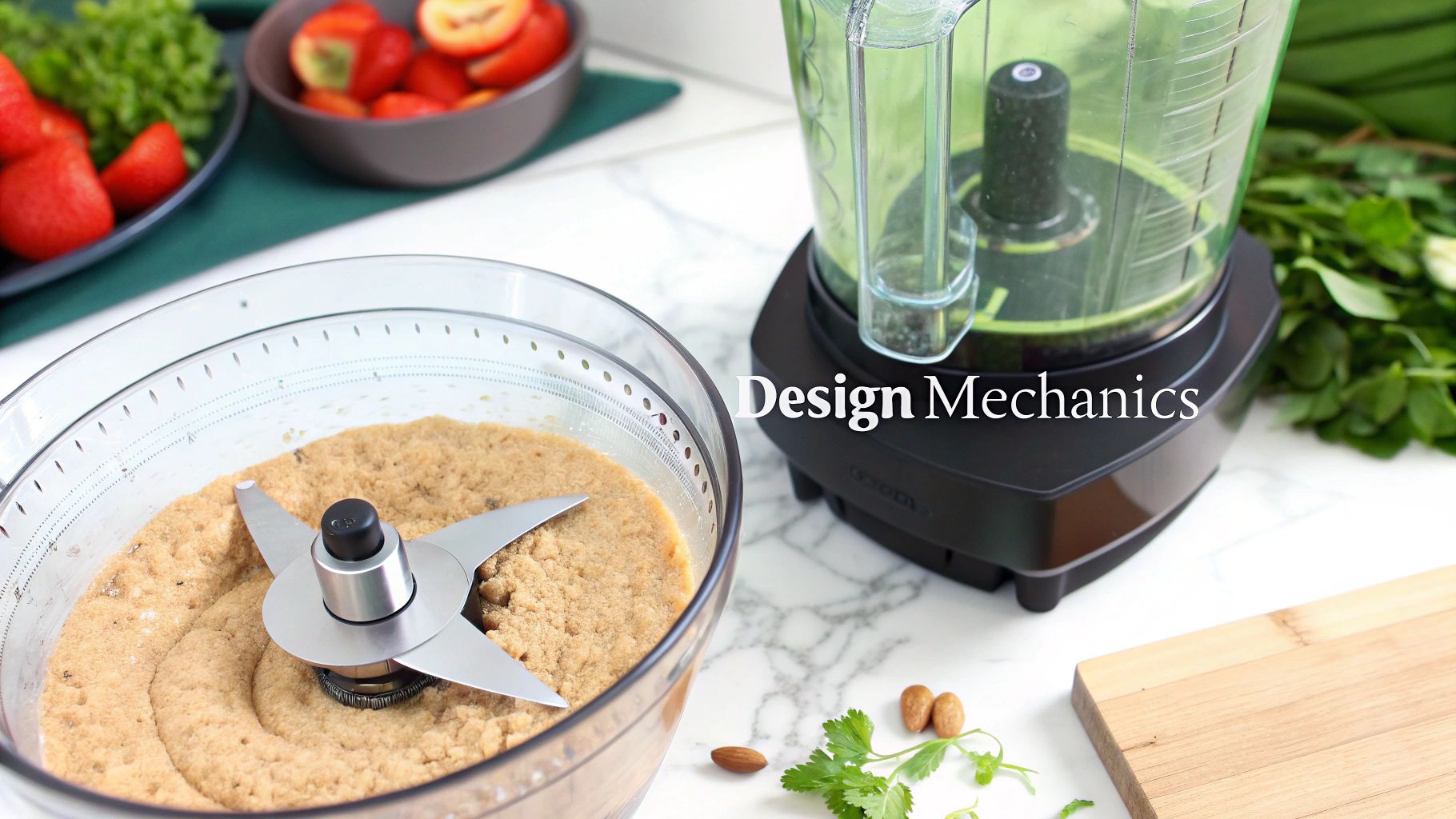
To really settle the food processor vs blender debate, you need to look under the bonnet. Why can a blender turn solid ice into fluffy snow but mangle a simple onion-chopping job? It all comes down to their fundamental engineering—from the shape of the container to the design of the blades.
A food processor is the ultimate kitchen multi-tasker, built for control and versatility. Its most obvious feature is a wide, flat-bottomed work bowl. This design gives ingredients plenty of room to spread out, which is perfect for chopping, shredding, and mixing. The motor is geared for torque, not speed, giving it the muscle to power through dense doughs and hard cheeses.
A blender, on the other hand, is a specialist engineered for one thing: liquefying. Its tall, narrow jar is designed to funnel everything downwards, straight into the blades. This shape is essential for creating a powerful vortex, that signature swirl that pulls solid chunks back into the blade path again and again until they’re silky smooth.
Blade Systems and Motor Function
The real magic, or mechanics, is in the blades and the motor that drives them. A food processor typically uses a removable S-shaped blade (sometimes called a Sabatier blade) that sits low in the bowl. It spins relatively slowly but with serious torque, acting like a super-fast knife to slice and mix without instantly turning your ingredients into a puree.
In contrast, a blender has a fixed blade assembly, usually with several prongs angled in different directions. These blades spin at incredible speeds—often hitting more than 20,000 RPM on high-powered models—to completely pulverise whatever they touch. The motor is all about speed, which is brilliant for breaking down tough, fibrous greens but not so great for tasks that need a delicate touch.
Think of it this way: a food processor is like a team of prep chefs with sharp knives, methodically dicing and mixing. A blender is a cyclone, violently pulling everything into a central point to create something perfectly uniform and liquid.
The Role of Container Shape
The container's geometry is no accident; it dictates what each appliance can do well. Here’s a quick breakdown:
| Design Element | Food Processor (Wide Bowl) | Blender (Tall Jar) |
|---|---|---|
| Shape | Wide and shallow | Tall and narrow |
| Purpose | Provides space for solids to be chopped, mixed, or kneaded. | Creates a vortex to pull ingredients into the blades for liquefaction. |
| Ideal For | Uniformly processing dry ingredients and thick mixtures like pesto. | Creating smooth, liquid-based recipes like smoothies and soups. |
| Limitation | Prone to leaking if you overfill it with thin liquids. | Struggles with small amounts or thick pastes without enough liquid. |
This difference is precisely why a high-performance blender is the king of silky-smooth green smoothies and creamy soups. If that level of performance is what you're after, checking out a premium Vitamix blender shows just how far that specialisation goes. Their power and blade systems are perfectly harmonised for liquefaction, making them an essential tool for anyone who prizes texture above all else.
A Head-to-Head Task Comparison
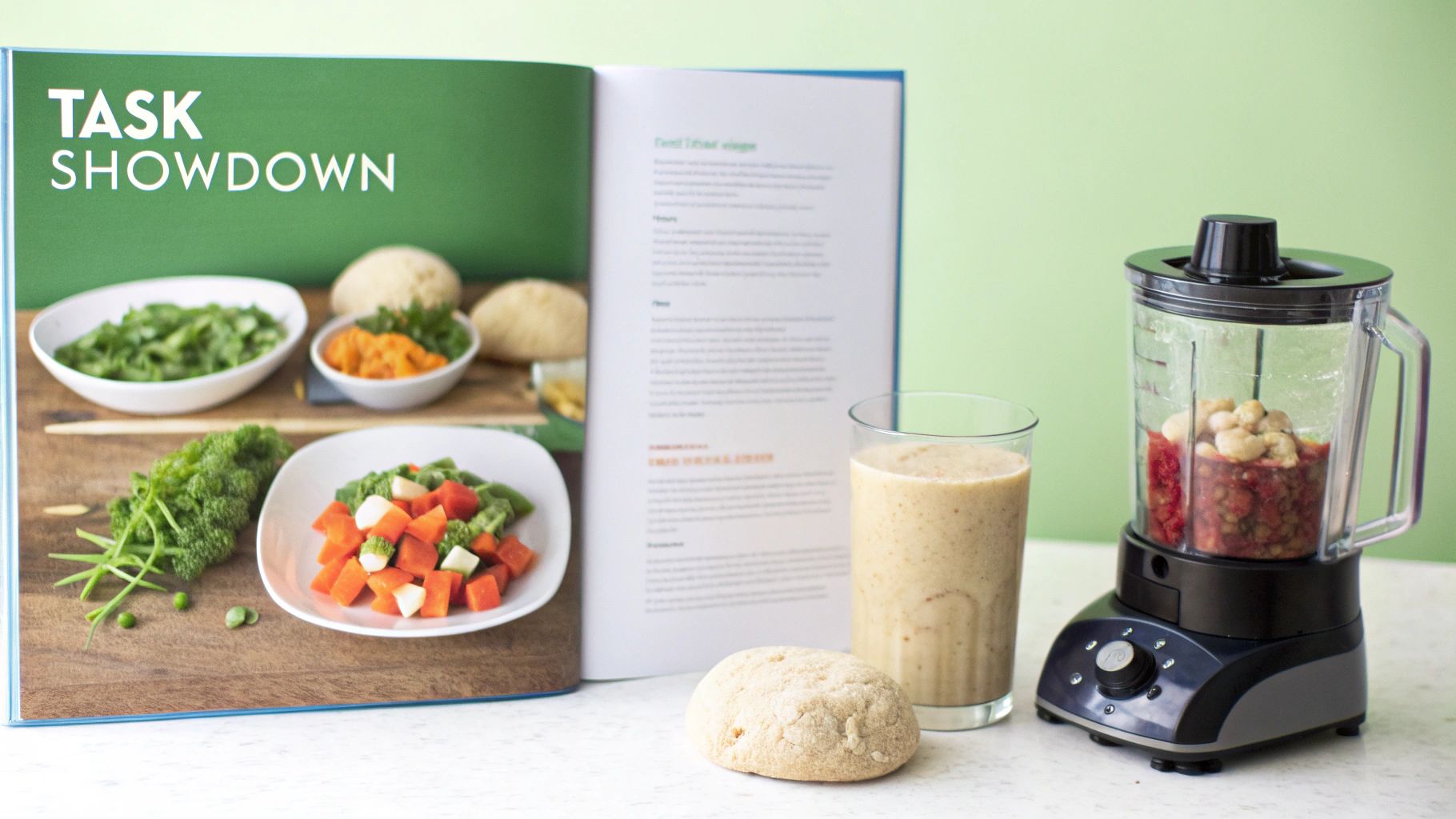
Knowing the design differences is one thing, but the real test is seeing these machines in action in the kitchen. Let's be honest, the final result of your recipe often hinges on picking the right tool for the job. So, we'll put them through their paces with a few common kitchen tasks to see which one truly delivers.
For most of us, the choice boils down to what makes life easier and gets the job done well. In New Zealand, there's a clear preference for powerful, electric models. Full-sized food processors are projected to grab nearly 46.8% of their market, with electric versions making up a massive 71.4% of sales. This tells me that Kiwi home cooks value the sheer efficiency these machines bring to meal prep, a trend you can explore further in these insights into domestic appliance retailing.
Task Performance Showdown
To get straight to the point, let's see how each appliance stacks up when faced with specific, everyday kitchen prep. The right choice becomes obvious when you know what you're trying to achieve.
| Kitchen Task | Food Processor Performance | Blender Performance | Winner |
|---|---|---|---|
| Chopping Vegetables | Excellent. Creates uniform pieces with a few quick pulses. Perfect for mirepoix or salads. | Poor. Creates a purée at the bottom and leaves large chunks on top. A watery mess. | Food Processor |
| Puréeing Soups | Fair. Can make a purée, but the final texture is often grainy or coarse. | Excellent. Creates a silky-smooth, velvety texture with no graininess. The ideal tool. | Blender |
| Making Nut Butter | Very good. Produces a thick, rustic-style nut butter. Easy to scrape down the sides. | Good. Creates a very smooth, often runnier nut butter. Requires a high-powered model. | Food Processor (for control) |
| Kneading Dough | Excellent. With a dough blade, it kneads bread or pizza dough quickly and efficiently. | Not possible. Will just spin the ingredients or stall the motor. | Food Processor |
| Crushing Ice | Fair. Produces uneven, chunky ice shards. Not ideal for drinks. | Excellent. Turns ice into fine, fluffy "snow" for cocktails or frozen drinks. | Blender |
| Shredding Cheese | Excellent. Uses a shredding disc to make quick work of a block of cheese. | Not possible. Will just clump the cheese into a ball against the blades. | Food Processor |
As you can see, it's less about which appliance is "better" overall and more about which one excels at the specific job you have in mind.
Chopping and Dicing Vegetables
When you need to prep veggies for a stew, salad, or a classic mirepoix, the food processor is your best friend. There's no contest here. Its wide bowl and sharp S-blade give everything room to move, ensuring vegetables like onions, carrots, and celery get processed evenly without being turned to mush. A few short pulses are all it takes.
Try this in a blender, and you'll see the problem immediately. The vortex pulls everything downwards, creating a sloppy purée at the bottom while big chunks remain untouched at the top. It’s simply not built for tasks that require texture. This is a common theme in kitchen gadgets; choosing between air fryers often comes down to the exact texture you're after, as you can see in this air fryer showdown in NZ.
Winner: Food Processor
Creating Smooth Purées and Soups
Now, let's flip the script. This is where the blender truly comes into its own. Its entire design—the tall jar, the powerful motor, and the blade system—is engineered to create that vortex and produce silky-smooth textures. Think of a creamy tomato soup, a velvety butternut squash purée, or homemade baby food. A good blender will pulverise every last fibre, leaving absolutely no graininess behind.
A food processor can technically make a purée, but the result will always be coarser. It just doesn't have the design or speed to liquefy ingredients with the same polished finish.
Winner: Blender
The key takeaway is simple: A food processor processes solid food, maintaining some texture, while a blender blends ingredients into a smooth, often liquid, state. One is for prep work, the other is for finishing.
Making Nut Butters and Thick Pastes
This one is a much closer race, and the winner really depends on how you like your nut butter. A food processor is fantastic for making thick, slightly rustic nut butters or chunky pastes like pesto. Its motor is built for the low-speed, high-torque work needed for dense mixtures, and the wide bowl makes it easy to scrape down the sides.
A high-powered blender can also get the job done, often producing a creamier, runnier result because it's designed to liquefy. However, a standard blender will likely struggle or even overheat without enough liquid, and its narrow jar can make it a real pain to get the thick paste moving.
Winner: Food Processor (for its texture control and versatility)
The Practical Side: Price, Cleanup, and Counter Space
Let's get real for a moment. Beyond all the talk of horsepower and blade design, the appliance you actually use is the one that fits your life—and your kitchen. That means thinking about three things that matter every single day: the price tag, the post-meal cleanup, and where on earth you're going to store it.
You can find both blenders and food processors for under $100, but the high-end models from premium brands can easily push past $800. Blenders tend to have a slightly lower starting price, but don't be fooled—the top-tier machines command a serious premium for those ultra-powerful motors that deliver velvety-smooth results. Food processors often start a bit higher, largely because they come bundled with a whole suite of attachments like slicing and grating discs.
Kiwi shoppers are also increasingly buying online, where convenience is king. High internet use across New Zealand has changed how we research and purchase appliances. You can see how these global trends are shaping the household blender market on cognitivemarketresearch.com to get a bigger picture.
The Cleanup Factor
When it's time to wash up, the blender is the clear winner. Hands down. Its design is beautifully simple: a jug, a lid, and the blade assembly. That’s pretty much it. Many even have a "self-clean" function—just add a drop of soap and warm water, blitz for 30 seconds, and you're done.
A food processor, on the other hand, can feel like a puzzle of parts when it comes to cleaning.
- The Work Bowl: It's big and can be awkward to wrestle into a sink or dishwasher.
- The Lid: That handy feed tube has all sorts of nooks and crannies perfect for trapping bits of food.
- The S-Blade: This thing is incredibly sharp and needs to be handled with care.
- Accessory Discs: Now you’ve got another two or three large, flat items to wash and find a place for.
For daily use, a blender's simple cleanup is a game-changer. When you're rushing to make a morning smoothie, the last thing you want is a major washing-up job before you've even had your coffee.
Counter and Storage Footprint
Finally, think about your kitchen's layout. Both appliances are hungry for precious counter space, but their shapes pose different challenges. Blenders usually have a smaller base but are quite tall, which can be a problem if you want to tuck them under low-hanging cabinets.
Food processors are the opposite—they're wide and squat, taking up a larger footprint on your benchtop or in a cupboard. That doesn't even account for storing all the extra discs and blades. In a smaller kitchen, every centimetre counts, a topic we dive into in our guide to small kitchen ideas. Even small appliance choices matter; learning how compact coffee grinders can maximise your kitchen space, for example, shows how every decision adds up to create a more functional kitchen.
Choosing the Right Appliance for Your Lifestyle
The food processor vs blender debate isn't about which one is universally "best"—it's about finding the right fit for your kitchen. There’s no single winner here. The best choice is the tool that slips right into your daily cooking routine and helps you achieve your culinary goals.
Ultimately, it all boils down to your lifestyle. Are you the type who’s always rushing out the door in the morning, needing a quick and healthy smoothie to go? Or do you live for weekend baking projects, making doughs from scratch and prepping elaborate meals? Answering that question is the first step to finding your perfect kitchen sidekick.
The Health Enthusiast and Smoothie Lover
If your day starts and ends with liquid nutrition, a high-powered blender is a must. We're talking daily green smoothies, post-workout protein shakes, or even homemade, silky-smooth almond milk. A blender's unique ability to completely pulverise tough, fibrous ingredients like kale or frozen berries is something a food processor just can't match.
For the health-conscious person on the go, a blender is more than an appliance; it's a wellness tool. Its sheer speed, efficiency, and simple cleanup (many models even have a self-cleaning function) are perfectly suited to a fast-paced, health-focused lifestyle.
The Passionate Home Cook and Baker
Are you the one who finds joy in making everything from scratch? Do you love the satisfaction of kneading your own pizza dough, shredding a block of cheese for the perfect mac and cheese, or whipping up a vibrant pesto? If this sounds like you, then the food processor is your undisputed champion. It’s a true kitchen workhorse, built for those prep-heavy jobs that would take forever by hand.
It shines where texture and control are key:
- Chopping: Getting perfectly uniform onions, carrots, and celery for a mirepoix.
- Shredding: Grating a pile of carrots for a salad or cabbage for coleslaw in just a few seconds.
- Mixing: Bringing together pastry dough or creating thick, luscious dips like hummus.
- Grinding: Making your own nut butters with a perfectly rustic texture.
A food processor is all about empowering your creativity by taking on the most labour-intensive parts of cooking. It’s the ultimate shortcut for anyone who loves tackling complex recipes or batch-prepping ingredients for the week.
This decision tree can help you visualise which path to take by considering your needs, budget, and kitchen space.
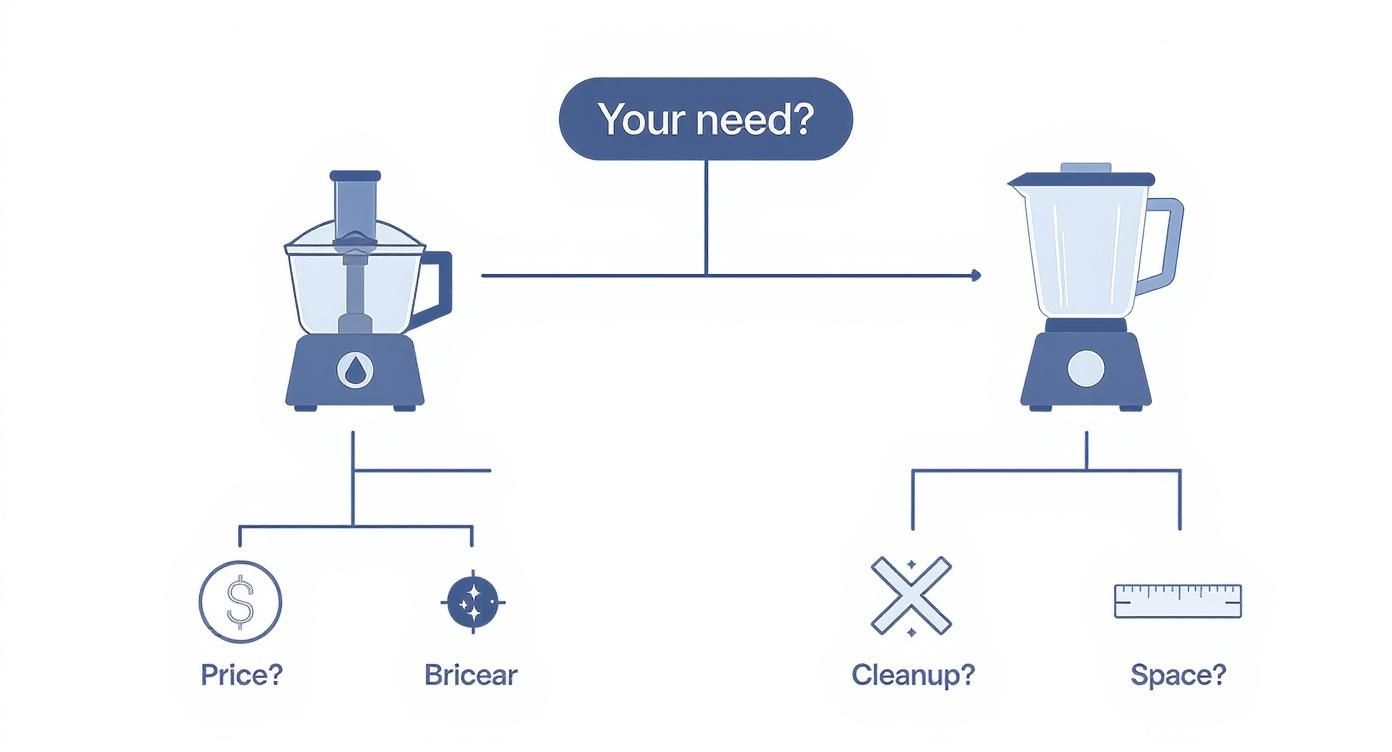
The main takeaway here is that your primary goal—whether you need to liquefy liquids or process solids—should be the biggest factor in your decision.
When you're weighing your options, it’s also smart to think about how a new appliance will fit in with what you already own. For a bit more perspective on building a functional kitchen, you might want to look into some other must-have kitchen essentials. Making a thoughtful choice means your new gadget will complement your existing tools, not just gather dust in a cupboard. So, be honest about your cooking style, and you'll make a purchase you'll be happy with for years.
Common Questions About Food Processors and Blenders
Even after a side-by-side comparison, some practical questions always come up. It's one thing to know the specs, but it's another to figure out how these tools really work in your kitchen. Let's clear up some of the common points of confusion so you can choose with total confidence.
Lots of people ask if they can just "make do" with one appliance for the other's job. This is where the food processor vs. blender debate gets interesting, because the answer isn't always a simple yes or no. The final result really hinges on your expectations and the power of the machine you own.
Can a Food Processor Make a Smoothie?
Technically, yes, but it won't be the smoothie you're hoping for. A food processor will certainly chop and mix all your ingredients, but it just doesn't have the high-speed blades or the vortex-creating jug needed to completely pulverise tough stuff like kale or frozen fruit.
What you'll end up with is a thin, often gritty mixture with a lot of pulp, not that silky-smooth drink you get from a proper blender. It’s drinkable, sure, but it's a world away from what a blender can do. Remember, food processors are built to create texture, not to liquefy.
Can a Blender Chop Vegetables?
This one is a hard no for most recipes. Blenders are designed to suck ingredients down into the blades and turn them into liquid. If you toss in solid vegetables like onions or carrots, the blades will turn whatever they can reach at the bottom into a watery mush, while leaving big, untouched chunks floating on top.
A few quick pulses might give you a very rough, uneven chop, but you’re far more likely to get a sloppy mess. For any recipe that needs distinct pieces of vegetables, a food processor is your only real option.
The bottom line is, while there's a tiny bit of overlap, trying to use these machines for things they weren't designed for usually ends in disappointment. Blenders liquefy, and food processors chop. Sticking to those roles will save you a whole lot of frustration in the kitchen.
Do You Really Need Both?
This is the big question, and the answer comes down to how you cook. If you're all about smoothies, creamy soups, and sauces, a good-quality blender is probably all you need. But if you’re a keen baker or find yourself chopping mountains of veggies for meals, a food processor is an absolute must-have.
For many home cooks, having both is a genuine game-changer. They aren't interchangeable; they’re complementary tools. Together, they cover the full spectrum of kitchen prep, from chopping and shredding right through to blending and puréeing.
What About an Immersion Blender?
An immersion blender (or stick blender) is another brilliant kitchen tool, but it serves a completely different purpose. It’s perfect for blending soup right in the pot or whipping up a small batch of mayonnaise. It's incredibly convenient and a breeze to clean, but it lacks the raw power of a countertop blender and the sheer versatility of a food processor. It’s a fantastic supplement to your kitchen arsenal, but it's not a direct replacement for either.
Ready to find the perfect appliance for your cooking style? At Folders, we offer a huge range of top-brand food processors and blenders to suit every need and budget. Find your ideal kitchen assistant today at https://folders.co.nz.