

How to Build a Home Library You'll Actually Love
Before you even think about buying a bookshelf, the first real step in creating a home library is asking a simple question: What is this space actually for?
Your answer to that question will shape every single decision that follows, from the type of shelves you choose to the softness of your reading chair. It’s what turns a room full of books into a personal sanctuary you’ll genuinely love spending time in.
Laying the Groundwork: Planning Your Perfect Library
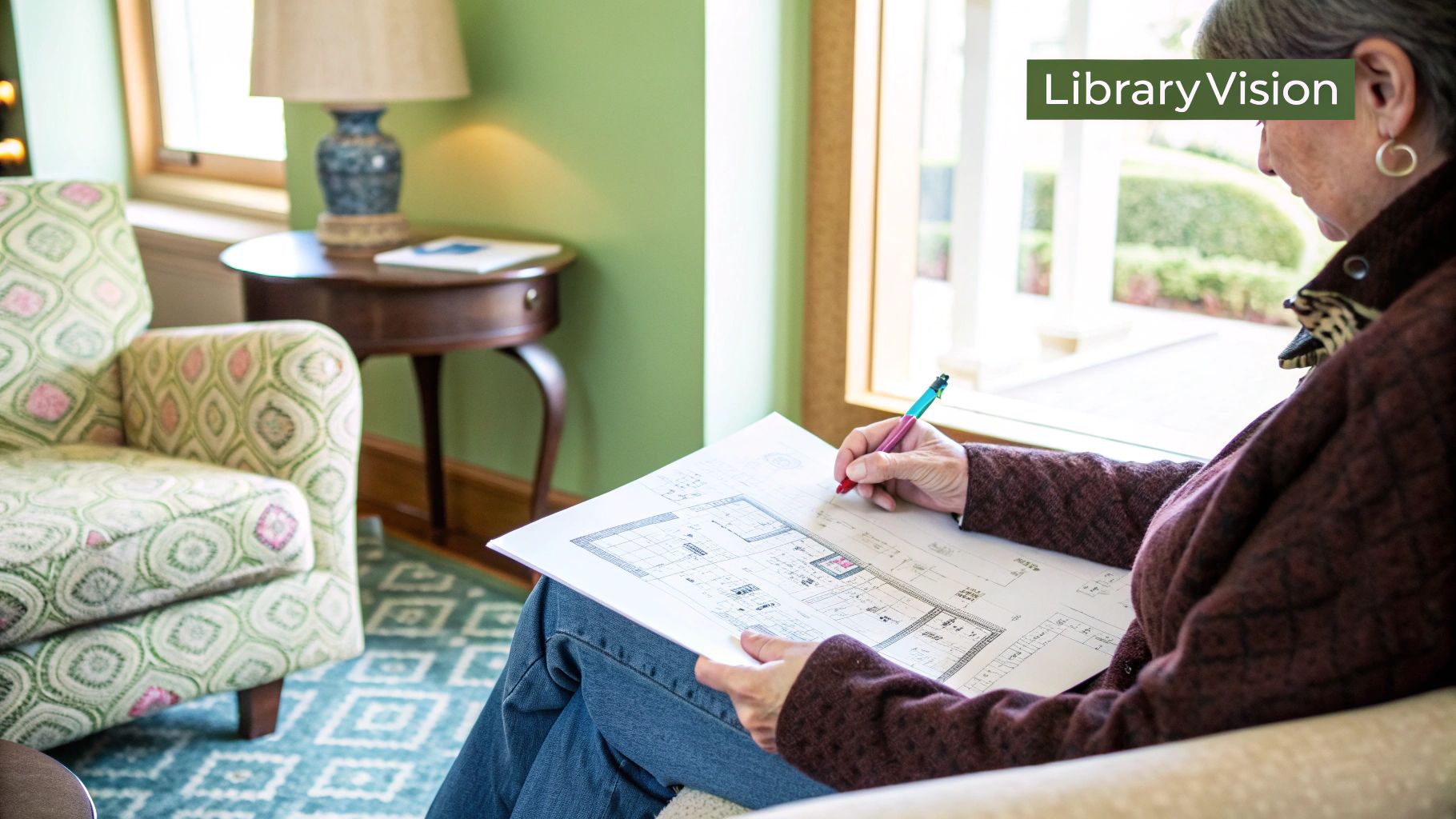
The most important work happens before you move a single book. It’s all about creating a clear vision, not just of how the library will look, but how it will feel and function. A library isn't just storage; it’s an active, living part of your home. Think of this initial planning stage as drawing the map that will guide you to a space that fits your life perfectly.
What kind of atmosphere are you trying to create? Are you dreaming of a quiet, studious corner built for deep focus, or a vibrant family hub where stories are read aloud and homework gets done? The purpose dictates the design. A solitary reading nook might call for a single, luxurious armchair and focused lighting, while a family space needs durable furniture and room for a bit of happy chaos.
What’s the Main Job of Your Library?
Start by picturing how you'll use this space day-to-day. Your answers here will shape the entire project, so it’s worth taking a moment to be honest with yourself.
- A Quiet Retreat: Is this your personal escape for reading and reflection? If so, your focus will be on pure comfort, quiet, and details that speak to you personally.
- A Family Hub: Will this be a central spot for homework, story time, and shared reading? You’ll need to prioritise durable materials, accessible storage, and seating that works for multiple people.
- A Social Showpiece: Perhaps you want a sophisticated space to display your collection and host interesting conversations. Here, aesthetics, statement lighting, and a clever layout become paramount.
- A Functional Workspace: Does your library need to pull double duty as a home office? This means integrating a proper desk, an ergonomic chair, and practical storage solutions from the get-go.
Figuring this out clarifies your priorities. A "showpiece" library might justify the expense of custom built-in shelving, whereas a functional family room would get more value from flexible, modular units that can adapt as your kids grow.
To help you get started, here’s a quick-glance table to help define the core elements of your library before you start building.
Your Home Library Blueprint
| Planning Element | Key Questions to Consider | Practical First Step |
|---|---|---|
| Purpose | What's the main activity? (e.g., quiet reading, family time) | Write a one-sentence "mission statement" for your library. |
| Space | Where will it live? (e.g., dedicated room, living room corner) | Measure the potential space and sketch a rough floor plan. |
| Budget | What's my absolute max spend? Where can I save/splurge? | List your top three "must-have" items and research their costs. |
Jotting down your answers to these questions gives you a solid, practical foundation to build upon.
Take Stock of Your Available Space
Now, let’s get practical. You absolutely do not need a grand, dedicated room to create a beautiful library. Some of the most charming libraries I’ve seen have been cleverly carved out of existing spaces.
Walk around your house with fresh eyes. Could that lonely corner in the living room, an unused alcove under the stairs, or even a wide hallway be transformed? Pay attention to the natural light. A sun-drenched nook is a dream for daytime reading, but keep in mind you’ll need to protect your book spines from direct UV rays to prevent fading over time.
Also, think about foot traffic. A library in a busy hallway needs streamlined, secure shelving to avoid accidental bumps. A quiet corner in a bedroom, on the other hand, can afford to be a bit more sprawling and cosy. The real trick is matching the library's function to the reality of the space you have. Learning how to use home decor to make a house your home can give you some brilliant ideas for integrating your library seamlessly.
Set a Budget You Can Stick To
Finally, the part everyone tries to avoid: money. A home library project can cost anything from a few hundred dollars to tens of thousands. Nailing down a budget early on saves a lot of headaches later and helps you spend your money where it matters most.
Your budget isn't a restriction; it's a creative guide. It forces you to prioritise what truly matters for your vision, whether that's the perfect reading chair or a custom-built shelf that fits an awkward space perfectly.
Decide where you’re willing to splurge and where you can save. You might invest in a high-quality, comfortable armchair you’ll have for 20 years but opt for more affordable shelving from a flat-pack retailer. Or, if showcasing a rare collection is the goal, custom joinery might be your big-ticket item, balanced with a cool vintage reading lamp you found at a second-hand shop.
Break your expected costs down into categories:
- Shelving: This is often the biggest piece of the puzzle.
- Seating: A comfortable chair, sofa, or even a window seat.
- Lighting: You'll want both ambient and direct task lighting.
- Décor: Rugs, art, and plants make it feel like home.
- Books: Don't forget the heart of the library!
Having a clear budget helps you make smart, intentional choices, ensuring your dream library becomes a reality without the financial stress.
Choosing Shelving That Fits Your Space and Style
With a vision in mind, it's time to choose the backbone of your library: the shelving. This is about so much more than just finding a place to stack your books. The right shelves will define the room's entire feel, shape how you use the space, and ultimately become a core part of how you enjoy your collection for years.
It’s easy to just grab a standard flat-pack bookcase, and there’s nothing wrong with that if you’re on a tight budget. But if you take a moment to explore the other options out there, you can turn a simple storage fix into a real design statement. What you choose will really come down to your budget, how permanent your setup is, and the look you’re going for.
Finding Your Perfect Shelving Match
The world of shelving is surprisingly varied. From grand, permanent fixtures to flexible, mix-and-match units, there’s a solution for every Kiwi home—whether you’re in a sprawling villa or a tiny city apartment.
Here’s a look at the most common options:
- Freestanding Bookcases: A classic for a reason. They're versatile, you can move them around, and they come in every style and price point imaginable. A solid rimu bookcase is a timeless investment, while a sleek, modern design can create a bold focal point. The biggest plus is their flexibility; if you move house, they come with you.
- Modular Systems: Think of these as building blocks for your book collection. Modular shelving is made up of individual cubes, boxes, or sections that you can arrange and rearrange to fit your space perfectly. They’re fantastic for a growing library or for squeezing into awkward spots like under the stairs.
- Custom Built-ins: For a truly seamless, high-end finish, you can't beat custom joinery. Designed to fit the exact dimensions of your room, built-ins deliver a polished, architectural feel. They are a significant investment, but they make use of every single centimetre and can even add to your home's value.
- Floating Shelves: If you lean towards a minimalist aesthetic or are working with a tight space, floating shelves are a brilliant choice. They give the illusion that your books are just hovering on the wall, creating a clean, airy look that doesn't feel heavy or overpowering.
Even a compact home can house an impressive library. It's all about integrating clever small space storage ideas into your shelving plan from the start.
Material Matters: Durability and Design
The material you pick doesn't just affect how your shelves look; it determines their strength and how long they’ll last. A flimsy shelf loaded with heavy hardbacks is just asking for trouble.
Solid wood—like pine, oak, or native New Zealand timbers—offers incredible strength and a classic warmth that gets better with age. Plywood is another robust and durable choice, often used in custom designs for its cool, modern layered edge. For those watching their budget, Medium-Density Fibreboard (MDF) is popular, especially when painted. Just be sure to check its weight capacity, as it can be prone to sagging over time.
As a rule of thumb, a standard shelf around 80cm wide should be at least 1.8cm thick to stop it from bowing under the weight of books. Anything thinner is really only suitable for paperbacks or a few light decorative items.
Before you commit to anything, get the tape measure out. Having precise dimensions is crucial for ensuring your new shelving will fit perfectly, saving you a world of frustration on assembly day. The same rules apply whether you're fitting a bookcase or a new fridge—for a simple walkthrough, check out our guide on how to measure your space for appliances and furniture.
This flowchart breaks down the basic process for choosing the right shelves.
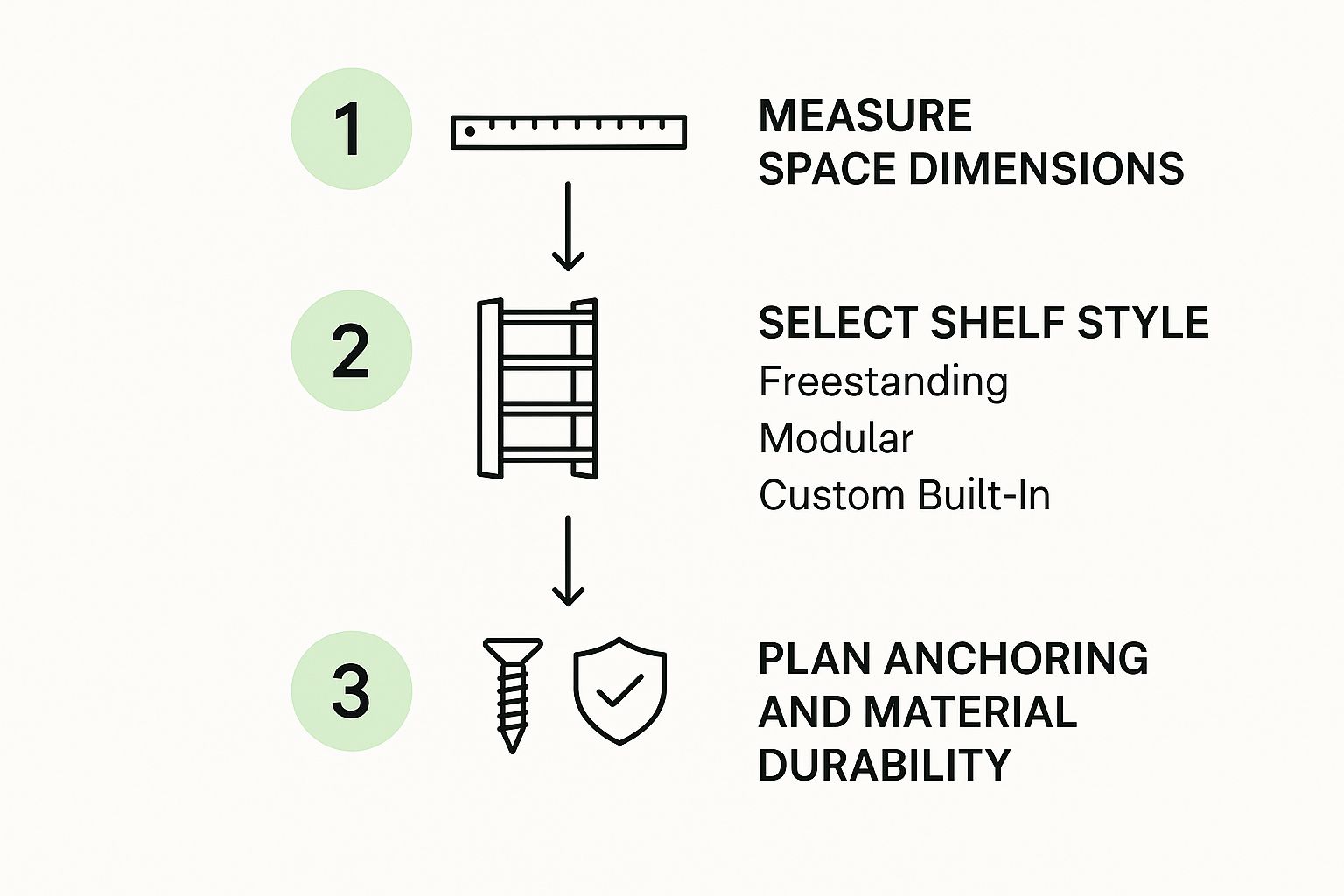
As you can see, these three things—measuring, style, and safety—are all linked. Getting them right is fundamental to building a home library you’ll love.
Safety First: Anchoring Your Shelves
I can't stress this enough: this is the non-negotiable part of the job, especially here in New Zealand. An unsecured bookcase is a serious safety risk, particularly if you have kids or pets running around. Any tall, freestanding unit must be securely anchored to the wall.
Most new bookcases come with an anti-tip kit, which is usually just a few brackets and straps. If you pick up a secondhand one that doesn't have a kit, they’re cheap and easy to find at any hardware store. It’s a simple job: attach one bracket to the top of the bookcase, the other to a stud in the wall, and then connect them. This one small step provides huge peace of mind, making sure your library remains a safe and stable sanctuary.
Curating a Meaningful Book Collection

A great home library is so much more than a room full of books; it's a personal story told on shelves. The real art of building a home library is in the curation—gathering a collection with intention, one that truly reflects who you are and where you've been. This isn't about a frantic rush to fill empty space. It's a slow, rewarding process of collecting titles that excite you, challenge you, and bring you comfort.
Your journey starts with the books you already own. Before you even dream of buying new ones, it’s worth taking a full inventory of your current collection.
Start with a Thoughtful Inventory
Lay your books out and handle them one by one. This is a fantastic way to reconnect with old favourites and honestly assess which ones no longer fit your life. As you sort, create three distinct piles: Keep, Donate, and Sell.
- The Keep Pile: These are the non-negotiables. They're the books you absolutely treasure, the ones you know you'll reread, or those that hold deep sentimental value.
- The Donate Pile: This pile is for books you enjoyed but are unlikely to pick up again. Local op shops, community centres, or school fairs are always grateful for good-quality donations.
- The Sell Pile: Got recent bestsellers, textbooks, or sought-after titles in great nick? Consider selling them. Second-hand bookshops or online marketplaces can help you fund your next book-buying adventure.
This initial clear-out is incredibly liberating. It makes physical room for new stories and helps you spot gaps or themes you’d like to explore next.
The Joy of the Hunt: Sourcing Your Books
With fresh space on your shelves, the real fun begins. Building a collection is a marathon, not a sprint, and the hunt is genuinely half the enjoyment. New Zealand is a treasure trove for book lovers if you know where to look.
A curated library is a living, breathing thing. It should grow and change with you, reflecting new interests, life stages, and discoveries. The goal isn't to finish; it's to continuously evolve.
Forget the pressure to buy everything brand new. Some of the most beloved books in any collection are those with a bit of history. Exploring the second-hand bookshops can uncover out-of-print gems and well-loved classics for a fraction of their original price.
Building a Balanced and Personal Collection
As you add to your library, think about creating a sense of balance. A collection filled with only one genre can start to feel a bit one-dimensional. It’s better to aim for a mix that keeps you engaged and curious.
- Mix Fiction with Non-Fiction: Try to balance captivating novels with books that teach you something new.
- Support Local: Make a point to seek out and celebrate our incredible New Zealand authors. Adding local voices grounds your library in a sense of place.
- Step Outside Your Comfort Zone: Every now and then, intentionally pick up a book from a genre you'd normally ignore. You might just discover a new passion.
- Consider Different Formats: While print is king for many, don't overlook other ways to read. Recent research shows 87% of New Zealand adults read a book last year, with a strong preference for physical copies. But, the same study noted men were more likely to use e-books or audiobooks, showing the value of a mixed-format library. You can discover more insights from the 2022 National Reading Survey from Read NZ Te Pou Muramura.
Ultimately, when deciding how to build a home library collection, the only rule is to choose books you genuinely want to read. Your library should be a source of joy and inspiration—a unique reflection of your personal journey through stories.
Organising Your Books for Easy Access and Appeal
Now for the best part. With your collection curated, you get to start arranging your books on the shelves. This is where your library truly comes to life, turning from a simple storage space into a beautiful, functional reflection of who you are.
There's no single "right" way to organise your books. Honestly, the best system is the one that clicks with your own brain and makes you happy every time you look at it. The goal is to make finding your next read a complete breeze while turning your shelves into a bit of a work of art. For some, that means strict logic; for others, it's all about the visual vibe.
Finding Your Organisational Style
First, think about how you naturally search for a book. When you want to find something, do you remember the author's name? The title? Or maybe just the colour of the spine? Your answer is the biggest clue to the system that will work for you.
- By Author: This is the classic library method for a reason. Arranging books alphabetically by the author's last name is logical, incredibly simple to maintain, and means you can find a specific writer's work in seconds.
- By Genre: This is my personal favourite for fiction. It involves grouping similar books together—all your sci-fi in one spot, your biographies in another. It's perfect if you're a mood-based reader who thinks, "I really feel like a mystery tonight."
- By Colour: A visually stunning choice that can turn your bookshelves into a genuine design feature. Arranging books in a rainbow or ombre pattern has a massive aesthetic impact, though I'll admit it can make finding a specific title more of a fun treasure hunt.
The most effective home libraries I've seen often mix and match. You might organise your fiction alphabetically by author but keep a separate, colourful section for all your beautiful art and design books. Don't be afraid to play around and see what feels right.
Beyond the Spine: Cataloguing Your Collection
As your library grows, keeping track of what you actually own becomes surprisingly crucial. Trust me, there's nothing more frustrating for a book lover than accidentally buying the same book twice! A simple cataloguing system is your secret weapon against this.
You don't need anything complex. A basic spreadsheet with columns for Title, Author, and Genre will do the job perfectly. If you want to get a bit more technical, apps like LibraryThing or Goodreads are fantastic. They let you scan barcodes with your phone, write reviews, and keep track of your reading wish list all in one place.
Taking a few minutes to do this pays off hugely in the long run. Not only does it save you money, but it also gives you a wonderful bird's-eye view of your collection, helping you spot which genres you might want to dive into next. For more ideas on getting your home sorted, you can explore the latest trends in storage and homeware in NZ.
Styling Your Shelves for Visual Appeal
Organisation isn't just about function; it's also about creating a space that feels warm and inviting. A few simple styling tricks can elevate your shelves from purely practical to personally beautiful.
- Vary Your Book Orientation: Don't just line everything up vertically like soldiers. Create some visual rhythm by laying a few books horizontally in short stacks. These stacks work brilliantly as bookends or as little platforms for small, decorative objects.
- Leave Some Breathing Room: It’s tempting, I know, but resist the urge to cram every shelf completely full. Leaving some empty space—what designers call "negative space"—makes the whole display feel less cluttered and more curated. Aiming for about 10-15% of open space on each shelf is a good rule of thumb.
- Add Personal Objects: Weave in items that tell your story. This could be anything from framed photos and small pieces of art to plants or souvenirs from your travels. These objects break up the endless rows of spines and make the library uniquely yours.
This approach is exactly what we see in our community spaces. Public libraries across New Zealand have seen a huge rise in use, with over 1.4 million active members. It just shows how much Kiwis value well-organised, interesting collections. By using that same principle of curated variety, you can create a personal library that's just as engaging.
Creating an Atmosphere That Invites You to Read
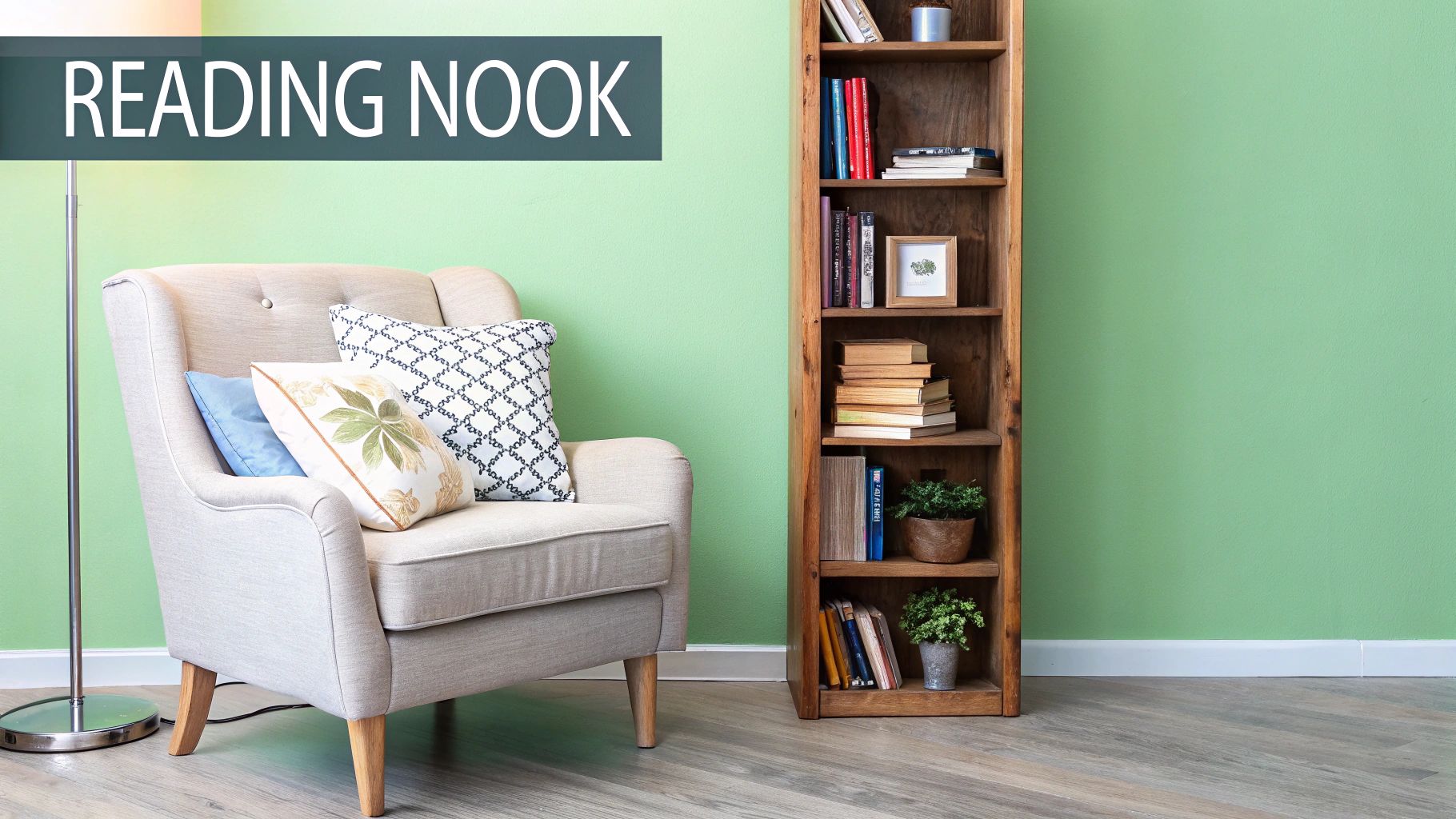
A truly great home library is more than just shelves stacked with books; it’s a personal sanctuary. This is the one space that should pull you in, making you want to disconnect from the world for a while. Getting that atmosphere just right comes down to the finishing touches—those essential elements that turn a room with books into your favourite escape.
It’s all about creating a space that feels comfortable, warm, and uniquely yours. Thoughtful lighting prevents tired eyes, a perfect chair begs you to curl up, and personal decor tells your story. These are the details that give your library its soul.
The Power of Good Lighting
I can't stress this enough: lighting is probably the most critical element in a reading space, but it's often an afterthought. Poor lighting can lead to eye strain and headaches, which completely ruins the relaxing experience you're after. The key is to think in layers.
A well-lit library cleverly combines three types of lighting to create a balanced, inviting, and practical environment.
- Ambient Light: This is your room’s overall illumination. It might be a central ceiling fixture or a few well-placed lamps. Its main job is to make the space feel warm and easy to move around in.
- Task Light: This is your dedicated reading light. Think of a floor lamp angled over your chair, a wall-mounted sconce, or a classic desk lamp. It provides focused, direct light right where you need it most—on the page.
- Accent Light: This is the subtle, decorative layer that adds a bit of drama. Picture small lights over a piece of art or targeted spotlights highlighting a specific shelf. It adds depth and makes the room more visually interesting.
If your library space is naturally a bit dim, it's worth looking into tips on how to brighten a dark room. For reading, always go for warm-toned bulbs (around 2700K) to get a cosy, yellow-hued glow rather than a harsh, sterile blue-white light.
Seating That Begs You to Stay
Your choice of seating will completely define how you experience your library. It should be the most comfortable spot in the house, a place you genuinely look forward to sinking into. The "perfect" chair is deeply personal, so take a moment to think about how you actually like to read.
Do you prefer to sit upright, or are you someone who loves to curl up with your legs tucked underneath you?
Your reading chair isn't just a piece of furniture; it's an invitation. It should signal comfort, relaxation, and the promise of a good story. Spend time testing options to find the one that feels like it was made just for you.
Here are a few classic options to consider:
- The Classic Armchair: You can't go wrong with a deep, upholstered armchair with a supportive back. Look for one with comfortable arms and pair it with an ottoman or footstool for the ultimate kick-back-and-relax setup.
- The Chaise Lounge: Perfect for readers who like to stretch out completely, a chaise lounge offers a touch of elegance and supreme comfort.
- The Window Seat: If your space allows for it, a built-in window seat is an absolute dream. It creates a cosy, self-contained nook with the added bonus of beautiful natural light.
Whatever you choose, don't forget to add soft textures like a plush throw blanket and a good cushion. These small additions are what make the space feel truly inviting.
Personalising Your Sanctuary with Decor
Now for the final layer: adding the personal touches that make the space entirely yours. Your library's decor should be a curated collection of things you love, reflecting your personality and your story. This is where you can have some fun and show who you are, beyond the books on your shelves.
Think about things like a soft rug to define the reading area and add warmth underfoot. Plants are another wonderful addition, bringing life and a bit of nature indoors while also improving air quality.
Wall art is another essential. It doesn't have to be expensive—it could be a favourite print, a framed map of a meaningful place, or your own photography. For more inspiration, have a look at our guide full of creative wall art display ideas.
This personal touch is especially important for families. For New Zealand families, building a home library is a brilliant way to foster a culture of curiosity and learning. With school resources often stretched, a well-chosen home collection can be vital. Research has shown that children who are read to regularly can hear up to one million more words by age five, which just shows the power of a book-filled home. By combining a great collection of books with an inviting atmosphere, you're creating a space that nurtures a lifelong love of reading.
Got Questions? We’ve Got Answers
Building your own library is a fantastic project, but it’s normal to have a few questions bubble up as you get started. From the nitty-gritty of book care to the practicalities of a tight budget, getting some expert advice can make the whole process a lot more enjoyable.
We get asked a lot about how to build a home library that really lasts. Here are our answers to some of the most common queries from book lovers around New Zealand.
How Can I Protect My Books from Sunlight and Humidity in NZ?
New Zealand's climate can be brutal on books. Our strong UV rays and pockets of high humidity are the arch-enemies of paper and bindings, so protecting your collection is key to making it last.
Direct sunlight is the big one—it can fade a book's spine in a shockingly short amount of time. The easiest fix is to place your shelves on a wall that never gets hit by direct sun. If your space doesn't allow for that, look into getting a UV-protective film for your windows. It’s a clear layer that can block up to 99% of those damaging rays without making your room feel like a cave.
Then there's the humidity, which can be a real problem in places like Auckland or down on the West Coast. Constant dampness leads to warped pages and, even worse, mould. A small dehumidifier tucked away near your shelves can be a lifesaver. You also want to encourage good airflow, so don't cram your books together too tightly and try to avoid storing them in damp basements or stuffy attics.
A good rule of thumb? If a room feels comfortable for you, it’s probably a good environment for your books too. Avoid those extreme temperatures and you’ll be on the right track.
What’s the Best Way to Start a Library on a Tight Budget?
You absolutely do not need a fortune to build a brilliant and personal book collection. The real secret is learning to love the thrill of the hunt for second-hand treasures.
Get into the habit of popping into your local op shops, checking out garage sales, and keeping an eye out for the big annual book sales that many public libraries run. You can unearth some absolute gems for just a couple of dollars. Second-hand bookshops are another goldmine, often with well-organised sections that make browsing a genuine pleasure.
Another clever trick is to put together a specific book wishlist and share it with friends and family before birthdays or Christmas. People are usually thrilled to give a gift they know will be truly wanted and loved. The goal isn't to fill your shelves overnight; it's to slowly build a collection of books you're genuinely excited about. And remember, while you're saving on books, investing in quality furniture that will last for years is always a smart long-term move.
How Do I Decide Which Books to Get Rid Of?
Letting go of books isn't a sign of failure—it’s just a natural part of being a reader! Culling your collection keeps it from getting stale and makes sure it's a reflection of who you are today, not just who you were years ago.
The right time to have a clear-out is usually when your shelves start to feel chaotic, or when you find yourself looking at a book and feeling absolutely no connection to it anymore. To take some of the emotion out of it, just ask yourself two straightforward questions:
- Will I honestly ever read this again? Be real with yourself here.
- Does this book have significant sentimental value?
If the answer to both is a firm "no," it's time for that book to find a new home. Donating it to a local charity, a school, or one of those little street libraries that are popping up everywhere is a great way to pass the story on for someone else to discover.