

How to Choose the Right Kitchen Knives for Everyday Cooking in NZ
When it comes to kitchen knives, you don't need a massive, expensive block set. The secret is finding a few key tools that feel like they were made just for you. For 99% of what you'll do in the kitchen, you really only need three core knives: a versatile chef's knife, a nimble paring knife, and a sturdy serrated knife.
Why The Right Knife Matters
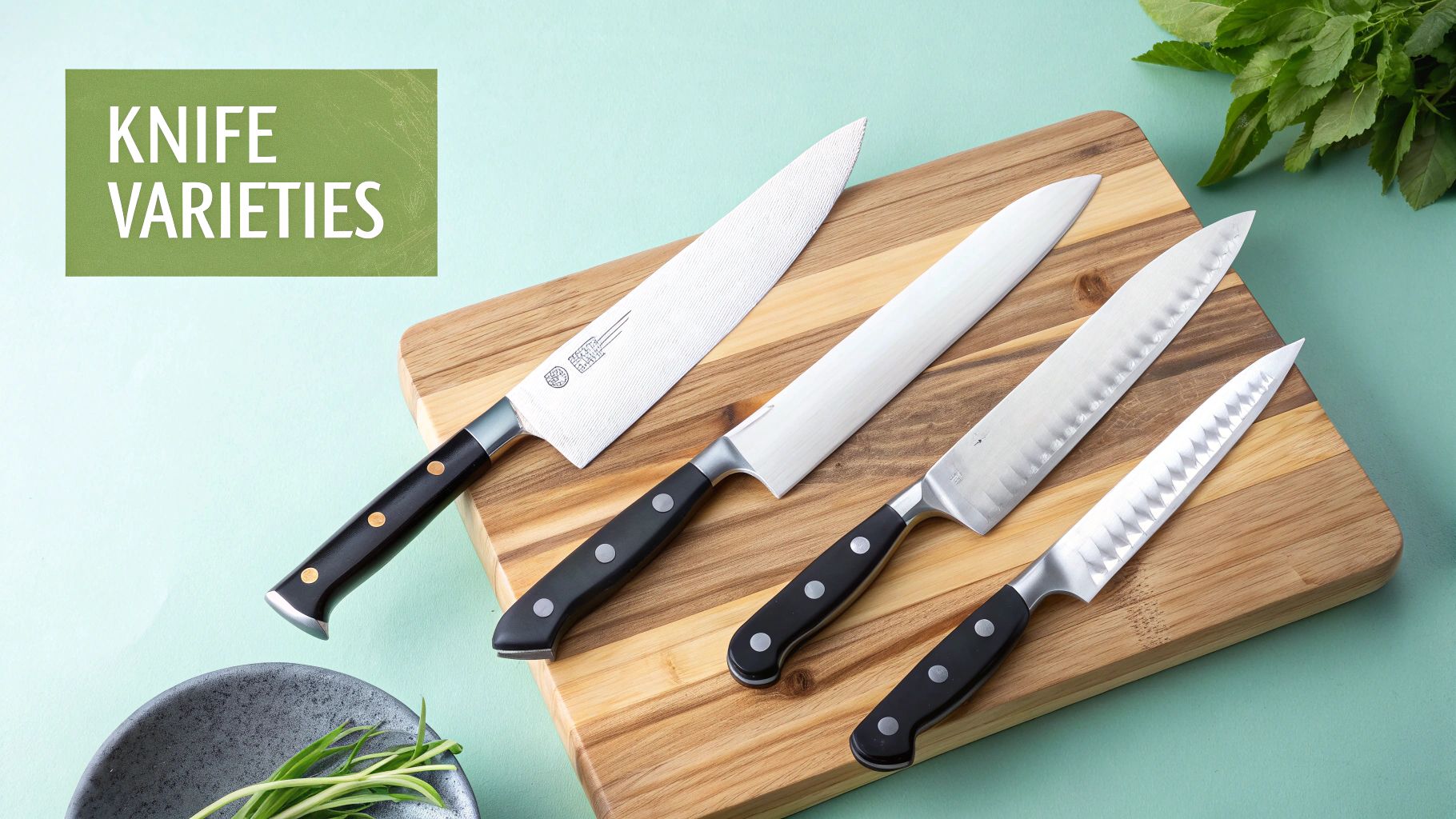
Choosing the right kitchen tools can completely change how you feel about cooking. Suddenly, what used to be a chore becomes a satisfying, creative process. It's a bit like finding the perfect appliance for your morning brew—a topic we explore in our guide on how to choose the best coffee machine. A good knife doesn’t just make you faster and more precise; it makes you a whole lot safer, too.
More Than Just a Sharp Edge
A dull or poorly balanced knife is a dangerous knife. It forces you to push harder, which dramatically increases the risk of it slipping and causing a serious cut. This isn't just a hypothetical problem. In New Zealand, the Accident Compensation Corporation (ACC) recorded around 19,000 knife-related injury claims each year between 2018 and 2020.
These numbers are a stark reminder that choosing a knife is about safety just as much as it is about performance. You need a tool that matches your skill and feels comfortable in your hand.
The goal is to find a knife that feels like a natural extension of your arm. Comfort, balance, and the right blade material are far more important than a flashy brand name, ensuring every cut is controlled and confident.
Building Your Foundation
Let's cut through the marketing jargon and focus on what really matters for the home cook. Before we dive into steel types or handle materials, we need to talk about the core trio of knives that will form the foundation of your kitchen toolkit.
Here's a quick look at the three knives that will handle almost everything you throw at them.
The Three Essential Knives for Any Kitchen
This table breaks down the undisputed workhorses of the kitchen.
| Knife Type | Primary Use | Why You Need It |
|---|---|---|
| Chef's Knife | The ultimate all-rounder for chopping, dicing, and mincing vegetables, meat, and herbs. | It’s the knife you'll reach for most often. Its versatility makes it indispensable. |
| Paring Knife | Peeling fruit, trimming vegetables, deveining prawns, and other detailed, in-hand work. | For all the small, precise jobs where a big chef's knife is just too clumsy. |
| Serrated Knife | Slicing through crusty bread, ripe tomatoes, and citrus without squashing the soft interior. | The saw-like edge grips and cuts where a straight edge would slip or tear. |
By starting with just these three essentials, you create a versatile, high-impact collection that's ready for almost any recipe. From here, you can add more specialised knives if you find you need them, but this is the perfect starting point.
Decoding Blade Materials and Construction
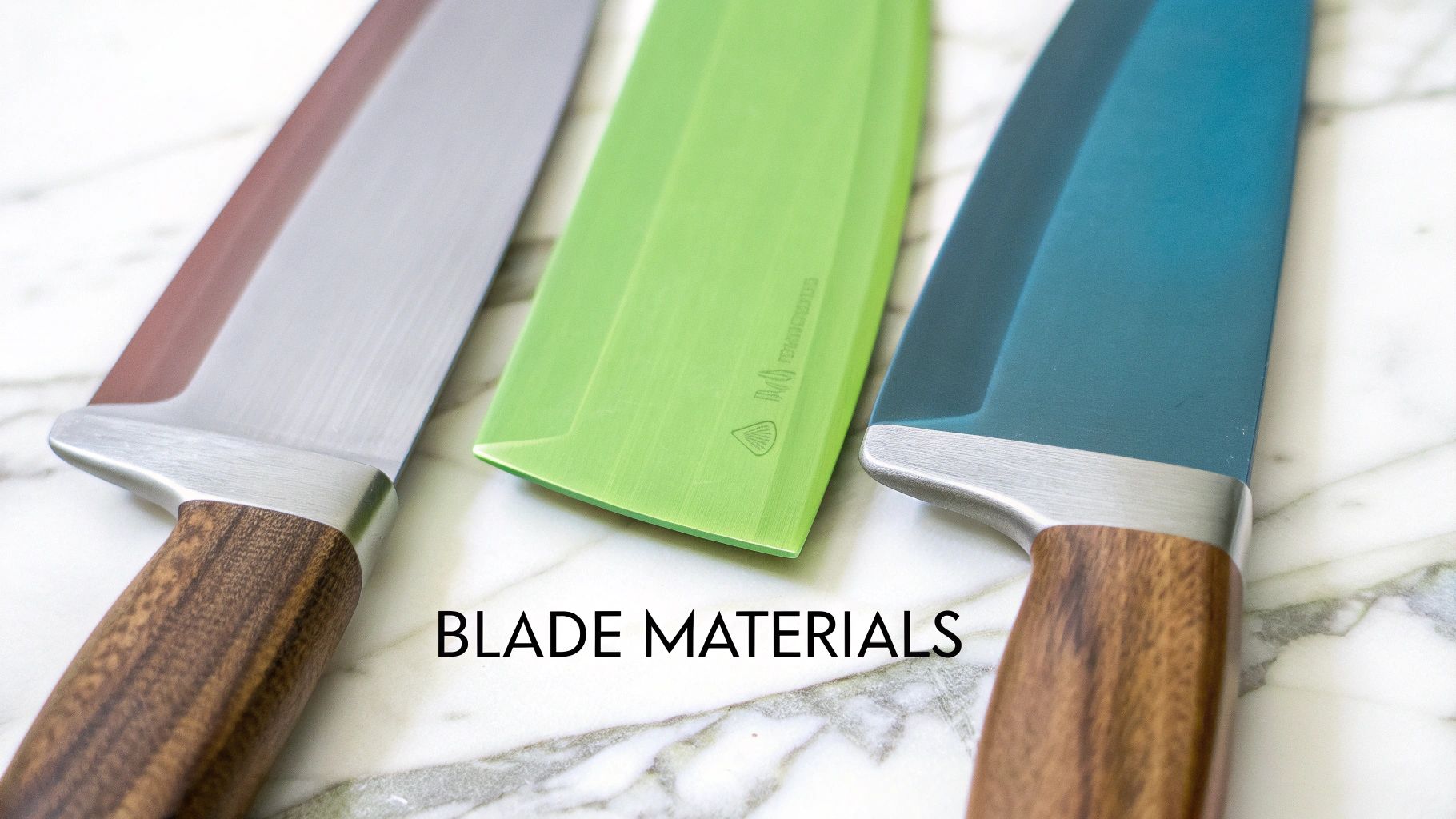
If you really want to understand a knife, look at its blade. The steel it’s made from and how it was crafted will tell you everything about its sharpness, durability, and how much work you’ll need to put in to keep it at its best. Getting your head around these differences is the secret to choosing kitchen knives you'll actually love using every day.
Most knives you’ll come across will fit into a few key categories. For the average home cook, the real decision is finding that sweet spot between top-tier performance and everyday practicality.
Stainless Steel: The Reliable All-Rounder
There’s a good reason stainless steel is the go-to for most kitchen knives. It’s tough, stands up to rust and stains, and is pretty forgiving, making it a brilliant choice for a busy family kitchen. A good quality stainless steel knife will hold a decent edge for a while and won't throw a fit if you accidentally leave it wet in the sink for a few minutes.
Honestly, its biggest drawcard is convenience. You get solid, reliable performance without having to commit to the high-maintenance rituals some other materials demand.
Carbon Steel: The Precision Specialist
Walk into a professional kitchen, and you’ll likely see chefs wielding carbon steel knives. This stuff is harder than most stainless steel, which means it can be sharpened to an incredibly fine, razor-sharp edge. It makes light work of precision jobs, like paper-thin vegetable slices or intricate butchery.
But all that performance comes at a price. Carbon steel is reactive, so it can rust if you don’t wash and dry it immediately after use. It will also develop a patina over time—a dark, mottled discolouration that actually helps protect the blade. Some people love this rustic, worked-in look; others don’t.
For many serious cooks, the incredible edge retention of carbon steel is well worth the extra fuss. It rewards you with cutting power you just can't get from anything else, but it definitely demands a bit of respect and a consistent cleaning routine.
As a major hub for kitchenware imports, we’re lucky in New Zealand to have access to a huge range of international brands. Knowing the difference between something like a durable German stainless steel and an ultra-sharp Japanese carbon steel is key to matching a knife to your cooking style.
Forged vs. Stamped Blades
Beyond the type of steel, how the blade is actually made makes a massive difference. You’ll hear the terms "forged" and "stamped" thrown around, and they simply describe two different manufacturing methods.
-
Forged Knives: Think of a traditional blacksmith. A forged knife starts as a single bar of steel that’s heated and hammered into shape. This process creates a thick, robust blade, often with a bolster (that chunky bit where the blade meets the handle) which adds weight and balance. They feel substantial in the hand but usually come with a higher price tag.
-
Stamped Knives: These are essentially cut, or ‘stamped’, from a large sheet of steel, a bit like using a cookie cutter. They’re then heat-treated for strength, sharpened, and fitted with a handle. Stamped knives are typically lighter, a bit more flexible, and easier on the wallet.
While forged knives have long held the reputation for being superior, modern manufacturing has closed the gap significantly. A well-made stamped knife can be a fantastic, high-performing tool for everyday cooking. If you're curious about specific brands, our guide to buying Global knives in NZ has some great insights.
Building Your Core Knife Collection
It’s tempting, I know. That giant, 12-piece knife block sitting on the shelf looks like the ultimate kitchen upgrade. But in my experience, most home cooks find they only ever reach for two or three of those blades regularly. The secret to a truly functional kitchen isn’t having more knives; it’s having the right knives.
A far better approach is to build your collection piece by piece. Start with a few individual workhorses that you'll use every single day. This way, you’re investing in quality tools for the jobs you actually do, rather than ending up with a mixed bag of average blades you’ll rarely touch.
The Indispensable Chef's Knife
If you can only have one knife in your kitchen, this is it. The chef's knife is the ultimate multi-tasker, and a good one will feel like a natural extension of your hand. Typically 20-25 cm (that’s 8-10 inches) long, its curved blade is perfectly designed for a smooth rocking motion.
This is your go-to for dicing onions, mincing garlic, chopping up a pile of veggies for a stir-fry, or slicing chicken breast. Honestly, this single tool will probably handle over 80% of all your cutting tasks. When you’re choosing one, focus on how it feels—the weight and balance are everything.
The Detail-Oriented Paring Knife
For all those small, fiddly jobs where a big chef's knife just feels clumsy, the paring knife is your best friend. At around 8-10 cm (3-4 inches), its small blade gives you incredible control for delicate, in-hand work.
You’ll find yourself reaching for it constantly for things like:
- Peeling an apple or a potato.
- Trimming the ends off green beans.
- Deveining prawns.
- Coring a tomato without making a mess.
It's the perfect partner to your chef's knife, taking care of the fine details with precision and ease.
The Often-Underestimated Serrated Knife
Don't just think of this as a "bread knife." A quality serrated knife is a problem-solver. That saw-like edge is specifically designed to grip and slice through foods with a tough skin and a soft centre, all without squashing them.
It's the hero for slicing a crusty loaf of sourdough, getting perfect slices from a ripe tomato, or cutting through citrus fruit. A good serrated blade cuts cleanly without tearing, which makes a world of difference to the texture of your food.
Building your collection around these three core knives—the Chef's, Paring, and Serrated—creates a powerful, minimalist toolkit. This is the foundation for efficient, enjoyable cooking, giving you the confidence to tackle just about any recipe that comes your way.
Exploring Beyond The Core Trio
Once you've got your essential three sorted, you can start thinking about adding a more specialised knife that suits your particular cooking style. This is where you can really tailor your toolkit to what you love to cook.
A Santoku knife, for example, is a fantastic alternative or even an addition to a classic chef's knife. Its Japanese name translates to "three virtues"—slicing, dicing, and mincing. With a flatter edge and a distinct 'sheepsfoot' tip, it’s brilliant for rapid, straight-down chopping rather than rocking. If you love making paper-thin vegetable slices, a Santoku might just change your life. If this sounds like a good fit for you, you can discover more about what makes the Santoku knife a kitchen favourite in our dedicated guide.
You might also consider a utility knife. It sits right between a paring and a chef's knife in size, making it a great all-rounder for jobs that are a bit too big for a paring knife but don't need the heft of a chef's knife—think slicing cheese or cutting a sandwich in half. And if you often break down whole chickens or handle large cuts of meat, a flexible boning knife is a non-negotiable tool for cleanly navigating around bones and joints.
How to Find a Knife That Feels Right
A world-class blade is useless if it feels clumsy or unsafe in your hand. When you're trying to choose the right kitchen knives, the ergonomics—how the handle feels, the weight, the balance—are every bit as important as the steel itself. You're looking for a tool that feels like a natural extension of your arm.
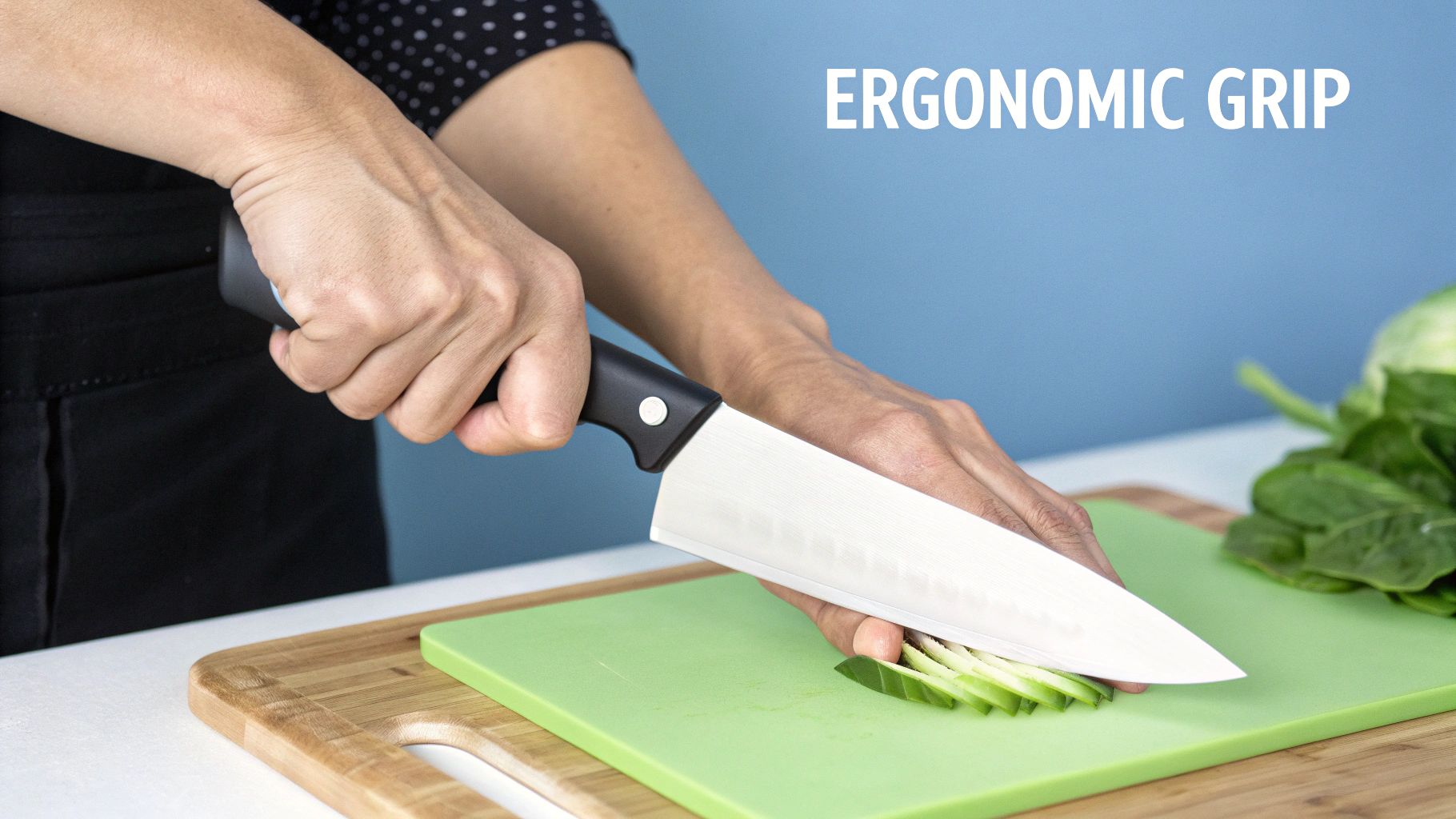
The only real way to know is to get your hands on it. Don't just pick it up; mimic how you’d actually hold it to chop. For a chef's knife, the best and safest way is the pinch grip: your thumb and forefinger pinch the blade right where it meets the handle, while your other fingers wrap around the handle. This gives you incredible control.
When you're holding it, pay attention. Does it feel solid and a bit weighty, or is it light and agile? There's no wrong answer here; it's purely about personal preference. A heavier knife often helps with the work, using its own momentum to slice through tough veges, but a lighter knife can be a lifesaver during a long cooking session, preventing your arm from getting tired.
Understanding Balance and Control
A well-balanced knife is an absolute dream to work with. The classic test is to place your index finger right under the bolster (that's the thicker part of steel where the blade joins the handle) and see if it teeters evenly.
That balance point is what makes a knife feel nimble and responsive, taking the strain off your wrist. It lets the knife pivot almost effortlessly, turning tasks like mincing garlic or dicing an onion from a chore into something smooth and controlled.
An unbalanced knife forces your wrist and forearm to compensate, which quickly leads to fatigue and increases the risk of the blade slipping. A balanced knife, on the other hand, feels practically weightless, letting you work faster and, more importantly, safer.
Choosing the Right Handle Material
The handle is your connection to the blade, so the material makes a huge difference to your grip, comfort, and even food hygiene. Here in New Zealand, you'll generally come across a few common options.
- Wood: Nothing beats the classic, warm feel of a wooden handle. They look beautiful and feel great, but they are porous. This means they need a bit of love—occasional oiling to stop them from cracking—and they should never, ever see the inside of a dishwasher.
- Composite: Materials like Pakkawood or Micarta give you the best of both worlds. They're made by compressing wood or fabric with resin, so you get the handsome look of wood but with far better durability and water resistance.
- Synthetic/Steel: Handles made from polypropylene or stainless steel are workhorses. They’re super durable, non-porous, and a breeze to clean. While they can sometimes get a bit slippery when wet, most modern designs have textured grips to keep your hand firmly in place.
Choosing the right handle comes down to balancing aesthetics, comfort, and how much maintenance you're willing to do. This table breaks down the pros and cons of each common material.
Comparing Knife Handle Materials
| Material | Pros | Cons | Best For |
|---|---|---|---|
| Wood | Comfortable, warm grip; classic aesthetic. | Porous, requires oiling, can crack if not maintained, not dishwasher-safe. | Home cooks who appreciate traditional feel and are willing to do the upkeep. |
| Composite | Durable, water-resistant, low maintenance, looks like wood. | Can be more expensive than basic synthetic options. | Anyone wanting the look of wood without the high maintenance. |
| Synthetic/Steel | Extremely durable, hygienic, dishwasher-safe, affordable. | Can feel less premium, may be slippery when wet if not textured. | Busy kitchens, professionals, or anyone prioritising hygiene and durability. |
Ultimately, the best handle is the one that gives you a confident, secure grip, even when your hands are a bit damp from washing vegetables.
This next image is a great visual guide to how different knife sizes stack up for various kitchen jobs.
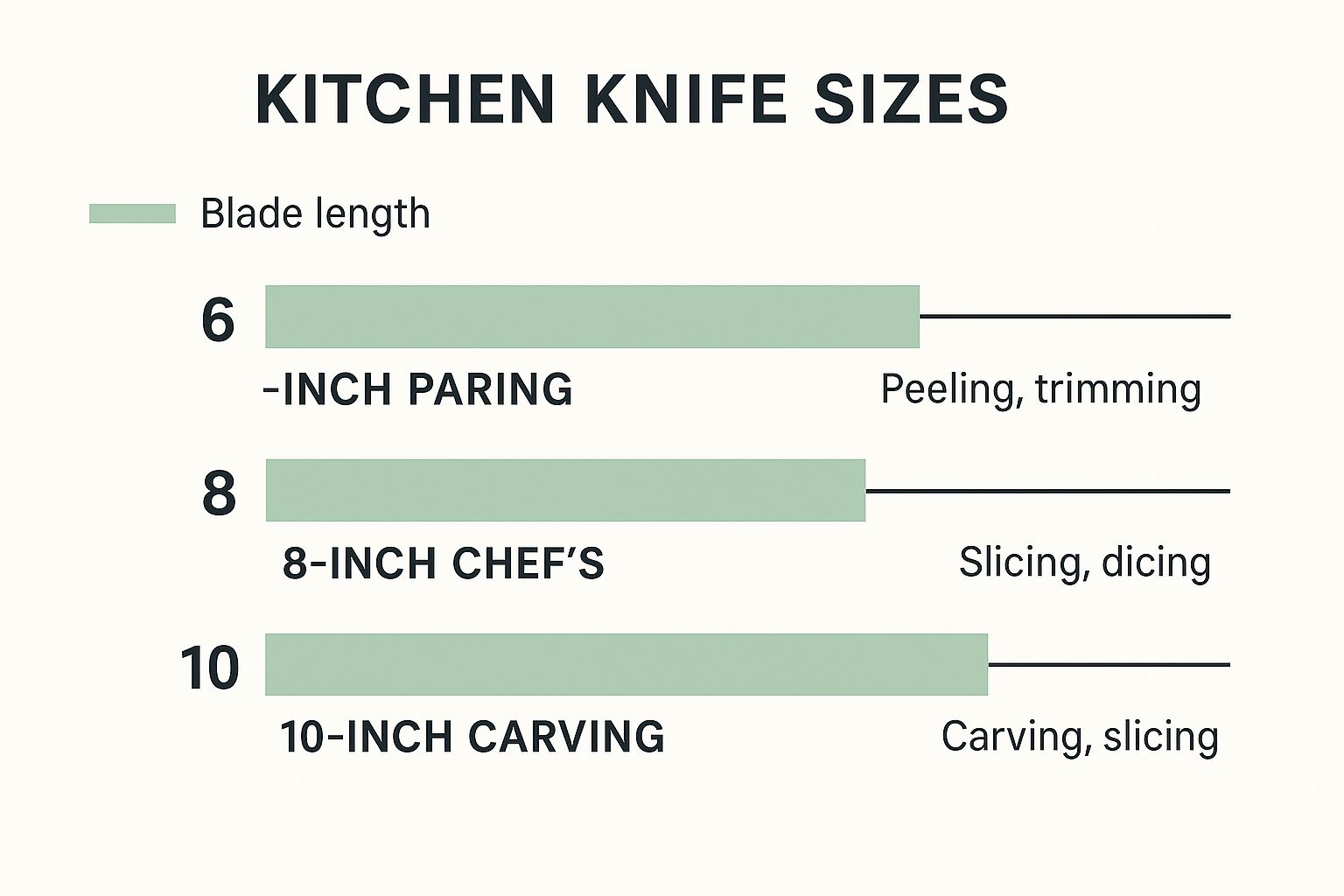
It’s a perfect reminder that bigger isn’t always better. It’s about matching the right tool to the task for the best possible control and efficiency.
Keeping Your Knives Sharp and Safe
Buying a quality knife is really just the first step. How you treat it from day one is what truly dictates its performance and how long it will last you. There's one golden rule that I can't stress enough: keep your good knives out of the dishwasher.
Seriously, just don't do it. The intense heat, abrasive detergents, and the chaos of being banged against other dishes will absolutely wreck your blade. It dulls the edge, can damage the handle, and might even lead to rust spots or tiny chips. The best approach is always a quick hand wash with warm, soapy water as soon as you're done, followed by a thorough drying with a tea towel before you put it away.
Honing vs Sharpening: What's the Difference?
People often mix up "honing" and "sharpening," but they are fundamentally different processes, and both are crucial for keeping your knives in top form. Getting your head around the distinction is the key to a lifetime of sharp, reliable blades.
-
Honing Realigns the Edge: Picture a honing steel as a tune-up tool. As you use your knife, its super-fine edge can get microscopically bent or folded over, which makes it feel dull even if it's technically still sharp. A honing steel simply pushes that edge back into alignment, restoring its cutting power almost instantly. For your main knives, you should be doing this often—maybe after every few big uses.
-
Sharpening Removes Material: Sharpening is the more heavy-duty job. It actually grinds away a tiny layer of steel to create a completely new edge. You only need to do this when honing just isn't cutting it anymore (pun intended). For most of us cooking at home, this might only be a once or twice-a-year task.
A sharp knife is a safe knife, but a honed knife is an efficient one. Regular honing keeps your blade in prime condition between sharpenings, making your daily prep work smoother and safer.
Smart Storage Protects Your Blades
Where you keep your knives is just as important as how you clean them. Throwing a great knife into a utensil drawer is a recipe for disaster. It's the fastest way to get a dull, chipped blade as it clatters against all the other metal in there.
Proper storage isn't just about protecting the blade; it's about protecting your fingers, too. For a deeper dive into blade care, have a look at our guide to proper kitchen knife cleaning and care.
Here are a few excellent storage solutions I've seen work well in many kitchens:
- Magnetic Strips: These are brilliant for freeing up counter space. Your knives are always in sight and easy to grab, and most importantly, the blades aren't touching anything that could dull them.
- In-Drawer Blocks: If you're like me and love a clear countertop, an in-drawer knife block is the way to go. It organises your knives safely and keeps them completely out of sight.
- Countertop Blocks: The classic wooden block is still a fantastic choice. Just try to find one with horizontal slots. With vertical slots, you can inadvertently dull the tip of your knife every time you drop it in.
By building these simple habits—hand-washing, frequent honing, and smart storage—you're not just looking after a tool. You're protecting an investment and making sure your knives are always a pleasure to use.
A Few Common Questions About Choosing Kitchen Knives
Even when you've got a handle on the basics of blades and materials, a few classic questions always come up. Getting these sorted can be the final piece of the puzzle, helping you choose your knives with real confidence.
Let's clear up some of the most common queries home cooks have.
Should I Buy a Knife Set or Individual Knives?
This is the big one, and my answer is almost always the same: buy individual knives. It's tempting to grab a full block—it looks complete and often seems like a good deal. But the reality is that most sets are padded with blades you'll rarely, if ever, touch. Do you really need a boning knife if you never break down a chicken, or a full set of six steak knives when you're only a household of two?
A far better approach is to put your money into three fantastic core knives: a chef's knife, a paring knife, and a serrated knife. This way, you get top-quality tools for the jobs you do every single day. You can always add a specialty knife down the track if you find a genuine need for one.
Buying knives one by one means you're choosing quality over quantity. You'll build a small, incredibly effective toolkit that's perfectly suited to how you cook, instead of having a block of so-so blades gathering dust.
This strategy ensures every dollar is well spent, going toward a tool that makes your time in the kitchen easier and more enjoyable.
What’s the Difference Between German and Japanese Knives?
Ah, the classic debate! At its heart, this is a difference in philosophy: think durability versus precision.
-
German Knives: These are the workhorses. Generally made from slightly softer steel, German knives are built to last. They’re exceptionally durable, less likely to chip, and can handle a bit of rough treatment. They're designed for resilience and are fantastic all-rounders.
-
Japanese Knives: These blades are all about finesse. They use harder, thinner steel, which allows for a much sharper, more acute edge. This makes them absolute wizards for delicate, precise slicing. The trade-off? That harder steel can be more brittle and prone to chipping if you’re not careful.
Your choice really hinges on what you value most. Do you want a robust, forgiving blade that can power through any task, or a razor-sharp instrument for surgical precision?
How Do I Know When My Knife Needs Sharpening?
It’s an old kitchen saying, but it's true: a dull knife is a dangerous knife. You have to push harder, which dramatically increases the risk of it slipping. Thankfully, the signs of a dull blade are pretty obvious once you know what to look for.
The easiest way to check is the tomato test. A sharp knife should glide through the skin of a ripe tomato without squashing it at all. If you find yourself pushing down and crushing the fruit, it’s definitely time for a sharpen.
Another great trick is the paper test. Hold a piece of paper by its edge and try to slice downwards through it. A sharp knife will cut it cleanly, while a dull one will just tear or snag on the edge.
Remember, regular honing keeps your edge aligned between sharpenings, but every knife eventually needs a proper session on the stones to restore its bite. If you're ready to learn how, our guide covers everything you need to know about how to sharpen kitchen knives.
At Folders, we believe the right tools can completely change your experience in the kitchen. Come and explore our curated selection of high-quality kitchen knives to find the perfect blades for your cooking style. Find your next favourite knife at https://folders.co.nz.